
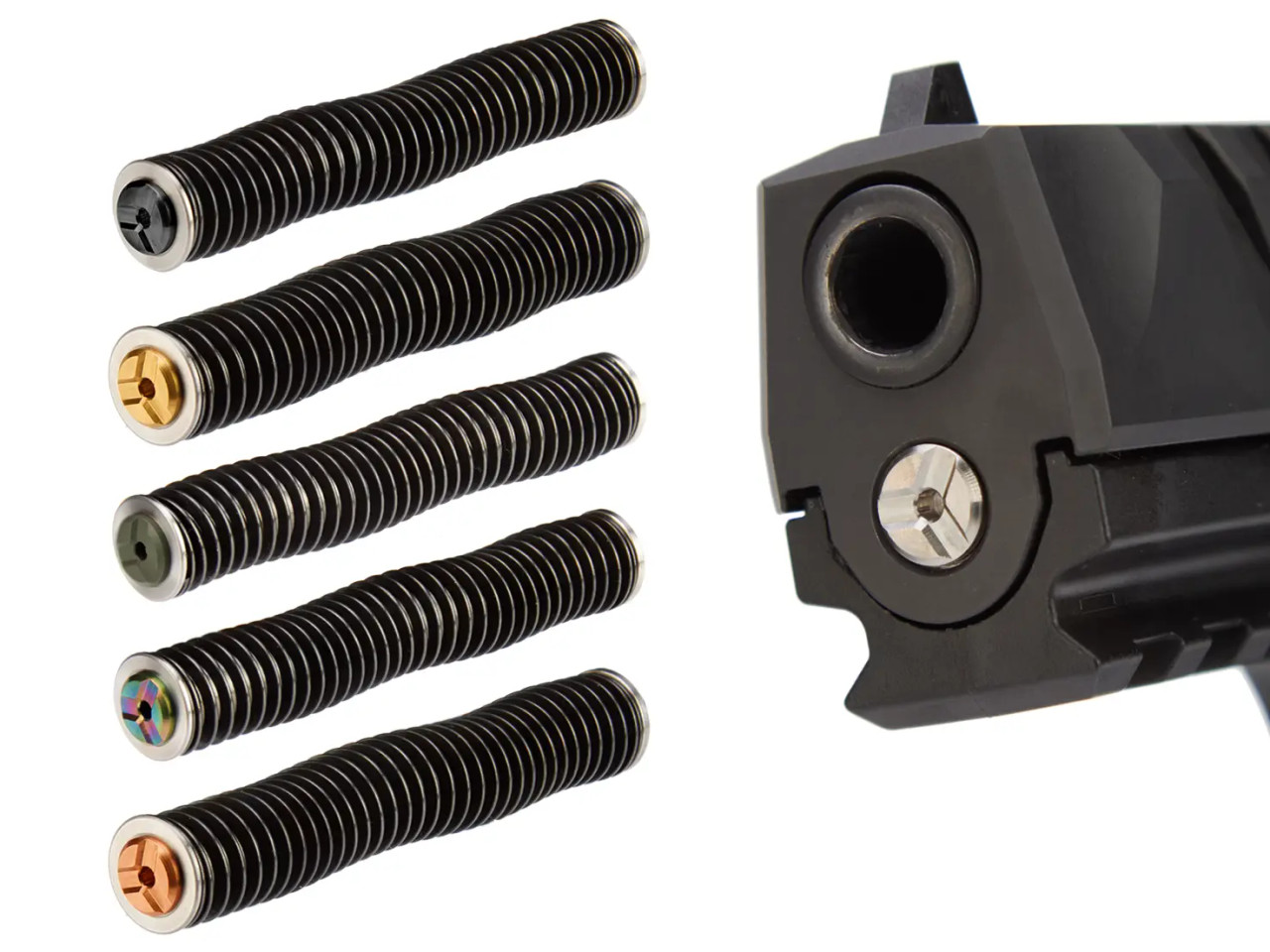
A buddy hands you his Walther PDP at the range, you rack the slide, and the recoil assembly inside feels like a plastic stick with a spring around it. Then someone at the next bay says he dropped in a solid metal one and the gun “shoots flatter.” So now you are wondering whether a steel Walther PDP guide rod is a real upgrade or just something that feels good in your hand at the counter.
We machine these rods in-house in Cheshire, Connecticut, so this is the version we would give a friend. Some of it is real. Some of it is feel. And one big piece has almost nothing to do with the rod at all.
The short answer on a Walther PDP guide rod
A steel guide rod adds a small amount of weight low and forward in the slide assembly. That weight can make the gun feel a touch more settled, and a solid machined rod will not flex or wear the way a lighter assembly can. Those are honest reasons.
What it will not do is transform how a PDP shoots. The PDP is already a soft 9mm. If you want to change how the gun actually cycles, you change the spring, not the rod material. We will come back to that, because it is the part most people get backwards.
What a Walther PDP guide rod actually does
The guide rod is the shaft the recoil spring rides on. When the slide travels back, the rod keeps the spring straight so it compresses in a clean line instead of kinking sideways. That is the whole job. It is a guide.
The rod is not what pushes the slide back into battery. The spring does that. The rod just gives the spring a track to run on. So when someone tells you a Walther PDP guide rod changed how their gun runs, what changed the cycling was almost always the spring that came with it.
What “my guide rod failed” usually means
People say “my guide rod failed” and mean a few different things. Usually the rod itself is fine and something else is going on.
- The recoil spring is tired. Springs are wear items. After enough rounds they soften, and the gun starts short-stroking or throwing brass weakly.
- The assembly is gunked up. Carbon and old lube under the spring can drag on the cycle.
- The wrong spring weight went in. A spring too light or too heavy for your load changes how the slide moves, and that gets blamed on the rod.
- The plastic factory assembly took a set or cracked at the tip after hard use.
How to confirm it
Pull the slide off and look at the recoil assembly. If the spring is kinked, collapsed unevenly, or noticeably shorter than a fresh one, that is your answer. If the rod is straight and the tip is intact, the rod was never the problem. Swap in a fresh spring of the correct weight before you spend money chasing a feel.
Factory vs steel vs tungsten
Three things get compared here, and only one of them is something we make for this platform. Here is the straight version.
Weight
The factory PDP recoil assembly is a light polymer unit [VERIFY: factory PDP RSA material confirmed via Walther forums and reviews as a 50N polymer assembly, not on the NDZ product page]. A stainless rod adds mass over that. Tungsten adds more mass than steel in the same space because it is denser. On a full-size 9mm like the PDP, the difference between factory and steel is real but modest, and the jump from steel to tungsten is smaller still.
The firing cycle
Extra mass in the recoil assembly slightly resists the slide’s rearward rush and gives the muzzle a little more to fight against on the way up. On a light micro pistol you can feel that change clearly because the gun has so little mass to begin with. The PDP is a heavier mid-to-full-size pistol, so the same added rod weight is a smaller slice of the total. You may notice it. You may not.
What it does not do
A heavier Walther PDP guide rod does not tighten your groups, and we are not going to put a recoil-reduction percentage on it. Anyone who hands you a number like that is guessing. What you get is a small change in feel and a part that will not flex or fatigue. Set your expectations there and you will not be disappointed.
Captured vs serviceable tip
Our rod uses a removable tip with a double Allen-wrench design, so you can take the spring off the rod for cleaning or to change spring weight. A sealed captured unit keeps the spring trapped on the rod permanently, which is simpler to drop in but means you cannot swap springs later. For a gun where you might tune the spring to your ammo, a serviceable tip is the more useful design.
The spring is the variable
Here is the part people skip. Spring weight is what decides how your PDP cycles, far more than the metal the rod is made of. A heavier spring slows the slide and can tame a hot load but may short-stroke light target ammo. A lighter spring runs soft loads cleanly but can let the slide slam hard on full-power defensive rounds. Match the spring to what you actually shoot, and the rod material becomes a secondary detail.
Does a Walther PDP actually need one?
Need is a strong word. Here is when it makes sense and when it does not.
- Worth it if your factory assembly is worn, cracked, or you simply want a solid machined part you can service and tune.
- Worth it if you shoot enough that swapping spring weights for different loads is something you will actually do.
- Worth it if you want a touch more settled feel and you understand that is what you are buying.
- Skip it if you are chasing tighter groups or a dramatic drop in recoil. The rod does not deliver that.
- Skip it if your factory unit is healthy and the gun runs your ammo without complaint.
One caution on spring weight. Putting in a spring that does not match your ammunition is the fastest way to create a malfunction that was never there. Too heavy and the slide may not fully cycle weak loads. Too light and the gun beats itself on hot rounds. If you are unsure, start near the factory rate and adjust from there.
Tungsten gives you more mass than steel in the same length, so people who want the absolute heaviest feel reach for it. We do not make a tungsten rod for the PDP, so we are not going to pretend one of ours is something it is not. For most PDP shooters, a solid stainless rod with the right spring covers the real-world need.
How to verify exact fitment
This is where most regret happens, so read the fitment list, not the marketing. Any product that says it “fits most 9mm” is a red flag. The PDP comes in several slide lengths and sub-models, and they are not all the same.
Our Walther PDP guide rod assembly is listed to fit these models:
- PDP 4″, 4.5″, 5″
- PDP Pro-E 4″, 4.5″
- PDP Pro-X PMM 4.6″ Full-Size and Compact
- PDP Pro
- PDP F-Series 4″ only
- PDP SF 4″, 4.5″, 5″
- PPQ 4″, 5″
- PPQ Q4 4″
- PPQ Q5 and Q5SF 5″
- P99 4″
And it does not fit these: PPQ45, PDP F-Series 3.5″, and PPQ SC. If your gun is on the no-fit list, this is not your part. Check the slide length stamped on your pistol and match it to the list above before you order.
What we build, and why
The NDZ Walther PDP Heavyweight Guide Rod Assembly is machined from solid stainless steel right here in Cheshire, Connecticut. We make it as a real serviceable part, not a sealed throwaway.
- Solid stainless steel rod, machined in-house in the USA.
- Removable tip with a double Allen-wrench design, so the spring comes off for cleaning or a weight change.
- ISMI recoil springs in Chrome Silicon, offered in 13 lb, 14 lb, 16 lb, and 18 lb, plus a Tuner Pack with all weights, or the rod alone with no spring.
- Lifetime warranty against manufacturing defects.
The Tuner Pack exists because we believe the spring is the variable. If you shoot a mix of loads, having every weight on hand lets you dial the gun in instead of guessing once and living with it.
So, should you do this?
Run it through this quick check before you decide.
- Inspect your current recoil assembly first. If the spring is tired or the part is damaged, that alone justifies a fresh assembly.
- Decide whether you want to tune. If yes, get a serviceable rod and a couple of spring weights. If no, a single matched spring is plenty.
- Be honest about why you want it. A solid machined part you can service is a fair reason. A magic recoil cure is not.
- Confirm fitment against the list above, by slide length and model, before you buy.
If you do need one
If you have checked the fitment and decided a solid serviceable rod is what you want, you can look at the NDZ Walther PDP Heavyweight Guide Rod Assembly with your choice of ISMI spring weight or the full Tuner Pack. For the bigger picture across platforms, our pistol guide rod upgrade guide walks through the same honest mechanics, and if you also run a Glock, the companion piece on whether you need a steel guide rod for a Glock 19 covers that platform the same way.
Frequently asked questions
Will a steel Walther PDP guide rod reduce recoil?
It adds a small amount of weight that can make the gun feel slightly more settled, but the PDP is already a soft 9mm, so the change is modest. We will not put a percentage on it. If you want to change how the gun cycles, the spring weight is what matters.
What spring weight should I run in my PDP?
It depends on your ammunition. Lighter springs run soft target loads cleanly, heavier springs better handle hot defensive rounds. If you are not sure, start near the factory rate and adjust. The Tuner Pack includes every weight so you can test on your own gun.
Is the NDZ rod captured or serviceable?
It uses a removable tip with a double Allen-wrench design, so the spring comes off for cleaning or a weight swap. That is more useful than a sealed captured unit if you ever want to tune the spring to your load.
Does this Walther PDP guide rod fit my model?
Check the fitment list above by slide length and sub-model. It fits a wide range of PDP, PPQ, and P99 variants but not the PPQ45, the PDP F-Series 3.5″, or the PPQ SC. Match the length stamped on your pistol before ordering.