
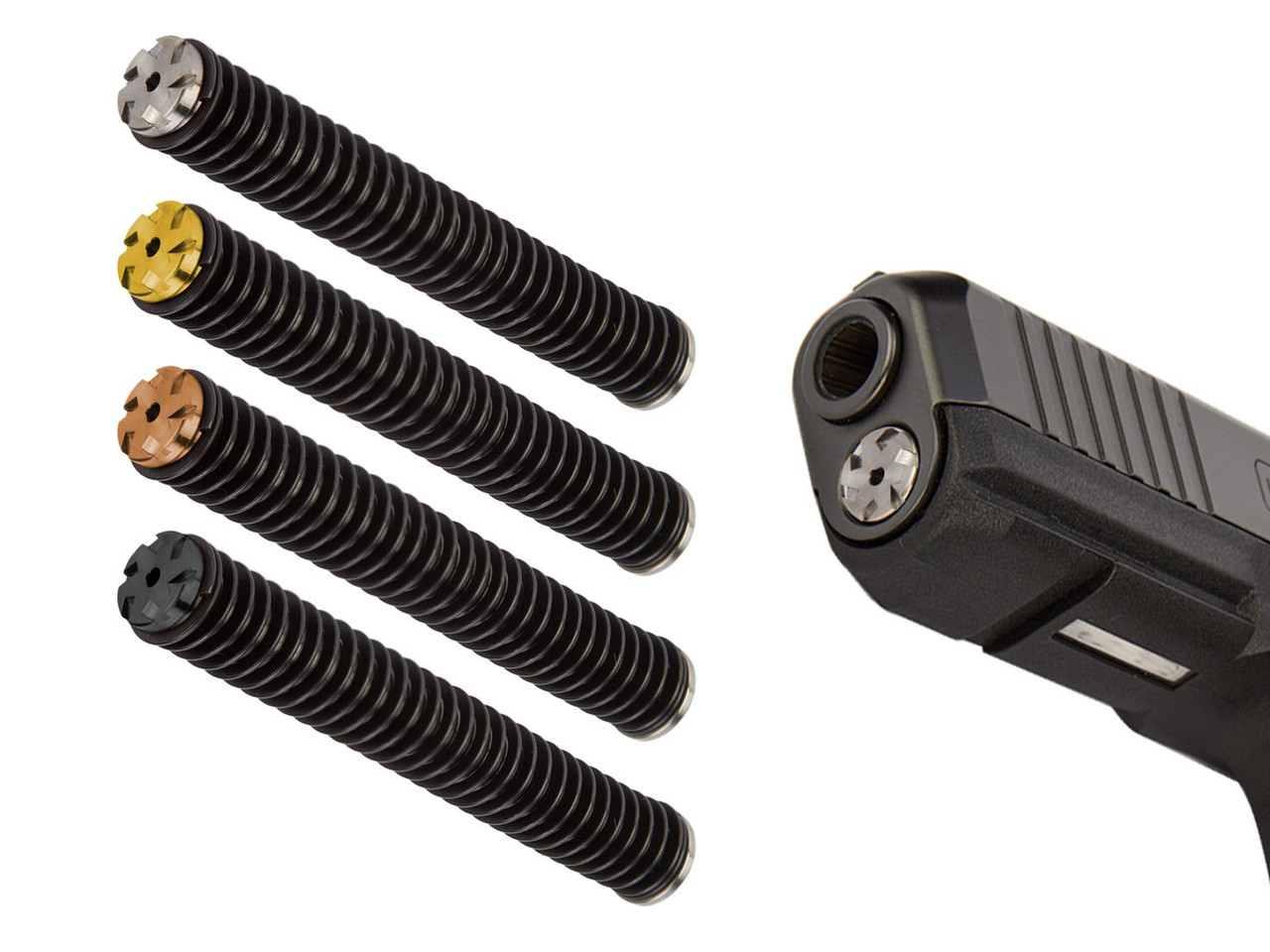
You picked up a Glock 17 Gen 5, or maybe the Glock 34 with its longer slide. Then a buddy at the range told you to ditch the factory Glock 17 guide rod and grab a “solid metal” one. It sounded right. The stock part is plastic, and plastic feels like the cheap thing you replace first.
Now you are at the “is this actually right for my gun?” stage, trying to figure out whether it is a real upgrade or just something people buy because it is easy to buy.
We machine these rods in-house in Cheshire, Connecticut, so yes, we have a stake in you buying one. We would still rather tell you the truth. A customer who understands what the part does comes back. Treat this as buyer education, not a sales pitch.
Here is when a steel rod is worth putting on a Glock 17 Gen 5, where it is only feel and preference, and the one thing that matters more than the metal it is made from.
The short answer on a Glock 17 guide rod
For a Glock 17 Gen 5 and the Glock 34, a steel rod is a durability and serviceability upgrade. It is not a recoil cure. Has your factory polymer rod cracked? Do you want a part you can rebuild instead of throw away? Then a solid stainless rod is a smart fix that lasts.
If your gun runs fine and you just want softer recoil, the math changes. The felt difference on a full-size 9mm this heavy is small, and your money does more on the range than on the rod.
One rule beats the metal every time: match the recoil spring weight to your gun and your ammo. The spring, not the rod, changes how the pistol cycles.
What a Glock 17 guide rod actually does
The Glock 17 guide rod is the shaft the recoil spring rides on. When you fire, the slide travels rearward and the spring compresses around that rod, then drives the slide forward to strip and chamber the next round. The rod’s job is simple and mostly passive. It keeps the spring straight and aligned so it compresses and rebounds in a clean line instead of kinking or binding.
That is it. The rod is a guide. It does not absorb shock, it does not tune the gun, and it does not decide how hard the slide slams or how the gun feels in your hand. The spring does the work. The rod just makes sure the spring can do it.
What “my Glock 17 guide rod failed” usually means
When someone says their guide rod failed, the recoil spring is usually the real culprit. Nine times out of ten the spring wore out, not the rod. Glock’s Gen 5 uses a captured polymer dual recoil spring assembly, so the rod and the nested spring system come as one sealed unit from the factory.
A common service interval is to replace that assembly roughly every few thousand rounds. That interval is about the spring losing tension, not the polymer rod snapping.
A tired spring shows up as the gun feeling different. Brass lands closer than it used to. The slide does not always lock back on an empty mag. You may get light primer strikes or the occasional failure to return fully into battery.
People feel that and reach for a steel rod when the gun was actually asking for a fresh spring. The polymer rod can crack or wear at the tip over a long life, and that is a genuine reason to replace it. Confirm it before you assume it.
How to confirm it before you spend a dime
Clear the pistol first. Check the chamber, drop the mag, and check it again. With the gun unloaded, field strip it and pull the recoil spring assembly out, then look at the polymer rod under good light.
Hairline cracks are real failures. So is a chewed or mushroomed tip, and a spring that no longer sits captured and tidy counts too. Now look at the spring itself.
Is the assembly loose? Do the coils look set? Are you well past a few thousand rounds? Then the spring is your suspect, not the rod. If your round count is low and nothing is cracked, your factory assembly is probably fine, and the upgrade is a choice rather than a repair.
Factory vs. solid steel vs. tungsten: what actually changes
Weight and where it sits
The factory Gen 5 rod is polymer and light. Our heavyweight stainless rod for this platform weighs 1.6 oz (45.30 g); the OEM rod weighs 0.7 oz (19.80 g). You are adding a little under an ounce.
That weight sits low and forward, under the barrel, near the muzzle end of the slide assembly. A full-size pistol already weighs over a pound and a half loaded, so that extra ounce is a real but small fraction of the total.
What a heavier rod does in the firing cycle
Adding mass low and forward shifts the gun’s balance slightly toward the muzzle, and it gives the recoil impulse a bit more weight to move. Some shooters feel a marginally flatter, more planted gun.
On a heavy full-size 9mm like the Glock 17 Gen 5 or the longer Glock 34, the honest description is small. You might notice it back to back on a timer or in rapid strings. It is not the kind of difference that transforms the gun. Anyone promising a dramatic recoil reduction from the rod alone is selling, not explaining.
What it does not do
A steel rod does not improve accuracy. It does not change your trigger, and it does not make a worn spring behave like a fresh one. By itself, swapping polymer for steel at the same spring weight does not meaningfully change how the slide cycles. The metal of the rod is not the variable here. Believe the mechanics, not the marketing.
Captured vs. non-captured
The factory Gen 5 unit is captured: the rod and spring are one sealed assembly, so when the spring is done you replace the whole thing. An aftermarket rod with a removable tip works differently. It lets you take the spring off the rod and swap it.
Our G17 Gen 5 heavyweight rod uses a removable screw tip with a double Allen-wrench design, so you can change the spring and rebuild the assembly instead of buying a new sealed unit every time. With a serviceable rod, you maintain the part. With a captured unit, you discard it. [VERIFY: NDZ product page describes the removable double-Allen screw tip but does not explicitly use the words “captured” or “non-captured” to classify this assembly.]
The spring is the variable that matters
This is the part most people miss. If you want to change how your Glock 17 Gen 5 cycles and feels, change the recoil spring weight, not the rod.
A lighter spring lets the slide travel more freely and can soften the feel with lighter loads, but go too light and the gun may not return fully to battery. A heavier spring slows the slide and can help tame hot or heavy loads, though go too heavy and the slide may not travel far enough to lock back on empty or to feed reliably.
The rod is the platform the spring rides on. The spring weight is the tuning. Get that backward and you will chase problems you created.
Does a Glock 17 Gen 5 (and Glock 34) actually need one?
- Recoil: Be honest with yourself here. On a full-size 9mm this size and weight, the felt change from a heavier rod is small. It is real for some shooters, but small. Do not buy it expecting a transformation.
- Durability after a failure: Genuine. Has your polymer rod cracked or the tip chewed up? A solid stainless rod is a stronger replacement you will not be repurchasing.
- Serviceability: Genuine, if you choose a rod with a removable tip. When the spring wears, you do not discard a sealed captured assembly. You unscrew the tip, drop in a fresh spring, and keep the rod.
- Feel and preference: Real, but personal. Plenty of shooters like the slightly more planted, muzzle-forward balance and the ability to tune spring weight. That is a legitimate reason to buy, as long as you know it is preference and not a fix.
One serious caution applies here. If you go with an aftermarket rod, match the spring weight to your gun and your ammo. The Glock 17 Gen 5 ships tuned around a stock spring rate.
Drop in a much heavier or much lighter spring without thinking it through and trouble follows. You can introduce failures to lock back, failures to return to battery, or feeding issues the factory setup never had. If you are unsure, start at or near the stock weight, and only change it if you have a specific load and a specific reason.
Tungsten comes up, so here is where it lands. Tungsten rods exist and are denser than stainless, so they pack more weight into the same space. For a competition shooter chasing every bit of muzzle-forward mass, that can be a deliberate choice.
It also costs more. On a duty or carry gun, it is usually more than the gun needs. We do not make a tungsten rod for this platform, so we are not steering you toward one of ours. The trade is straightforward: more density, more cost, marginal real-world payoff outside competition.
How to verify exact fitment for your Glock 17 guide rod
Guide rods are generation-specific and frame-specific, and Glock did not make this easy. A Gen 5 rod does not fit a Gen 3 or Gen 4 gun. A compact rod does not fit a full-size frame. Before you buy anything, know four things about your pistol: the make (Glock), the model (17), the generation (Gen 5), and the variant if it has one. Read it off the gun and the box, not off memory.
Does a listing say “fits most 9mm Glocks” or “universal”? Treat that as a red flag and move on. Recoil assemblies are not universal. A vague fitment claim usually means someone is hoping close enough is good enough, and it is not.
For our G17 Gen 5 heavyweight rod, the listed Gen 5 fitment is the Glock 17, Glock 22, Glock 31, and Glock 35 in 9mm. The page also notes it does not fit other Glock models or generations. The Glock 17 and Glock 34 Gen 5 share the same recoil spring assembly, so this rod is intended to cover the Glock 34 as well. [VERIFY: the NDZ product page’s named Gen 5 fitment list reads G17, G22, G31, G35; the Glock 34 is not individually named on the page, so confirm Glock 34 fitment with NDZ before ordering specifically for a G34.]
What we build, and why it is made the way it is
Our Glock 17 Gen 5 heavyweight guide rod is machined from solid stainless steel. We cut it right here in Cheshire, Connecticut, USA, at our shop at 30 Diana Court. The heavyweight body comes in at 1.6 oz (45.30 g); the factory polymer rod comes in at 0.7 oz (19.80 g). That is where the added muzzle-forward mass comes from. Finish options include polished stainless, black nitride, PVD, and Cerakote, so you can match it to your build.
The tip is a removable screw with a double Allen-wrench design, so the rod is serviceable and you swap the spring instead of replacing the whole assembly. We pair it with ISMI recoil springs.
You can order it in 11 lb, 13 lb, 15 lb, 17 lb (the stock-equivalent weight), 20 lb, or 22 lb. You can also get it as the rod alone with no spring, or choose the Tuner Pack, which includes every spring weight if you want to dial in a specific load yourself. Every NDZ part carries a lifetime warranty against manufacturing defects. That is easy to stand behind when you cut the part yourself.
So, should you do this?
- Your factory polymer rod is cracked or the tip is worn: Yes. Replace it with the solid stainless rod. This is the clearest case for the upgrade.
- You want to maintain and tune instead of discard: Yes. A removable-tip rod plus ISMI springs lets you rebuild rather than rebuy, and tune spring weight to your load.
- You shoot a lot and rotate spring weights for competition or specific ammo: Yes, especially with the Tuner Pack, so you can experiment without buying springs one at a time.
- You like the slightly more planted, muzzle-forward feel: Sure, as a preference. Just go in knowing it is feel, not a fix.
- Your gun runs perfectly and you only want softer recoil: Probably not. The felt difference on a full-size 9mm is small, and your dollars buy more improvement as range time and ammo.
- You think a steel rod alone will change how the gun cycles: No. Change the spring weight for that, and do it carefully.
If you do need one
You have read all of this and a steel rod still makes sense for your gun. The path is straightforward. Confirm your model and generation first. Then look at the NDZ Glock 17 Gen 5 heavyweight guide rod. It is machined from solid stainless in Cheshire and ships with your choice of ISMI spring weight or the full Tuner Pack.
Start near the stock 17 lb spring unless you have a specific load that calls for something else. Want the bigger picture on how these parts work together? Our guide rod and recoil spring guide walks through the whole system. And if you run the compact frame, our companion piece covers whether you need a steel guide rod for the Glock 19 Gen 5. It treats that platform the same honest way.
If your gun runs fine, keep your money. A Glock 17 Gen 5 that feeds, locks back, and returns to battery every time does not need an upgrade. Shoot it, replace the spring on schedule, and spend the difference on ammo. That is advice from the people who machine the part. We will still be here when you actually need one.
Frequently asked questions
Does a steel guide rod reduce recoil on a Glock 17 Gen 5?
Only marginally, and not the way most people expect. A heavyweight rod adds a little under an ounce of low, forward mass, and some shooters feel a slightly flatter gun. On a full-size 9mm this heavy, the difference is small. The recoil spring weight, not the rod material, governs how the slide cycles and how the gun feels.
Will a Glock 17 Gen 5 guide rod fit a Glock 34?
The Glock 17 and Glock 34 Gen 5 use the same recoil spring assembly, so a Gen 5 G17 rod is intended to cover the Glock 34 as well. Always confirm the exact listed fitment before ordering, since recoil assemblies are generation-specific and frame-specific. [VERIFY: the NDZ product page names G17, G22, G31, G35 Gen 5 in its fitment list and does not individually name the G34, so verify G34 fitment with NDZ if you are buying specifically for that gun.]
What spring weight should I run in my Glock 17 Gen 5?
For general use with standard 9mm loads, start at or near the stock-equivalent weight. On our rod, that is the 17 lb ISMI spring. Only move lighter or heavier if you have a specific load and a clear reason. Watch for failures to lock back (often too heavy) or failures to return to battery (often too light). If you want to experiment, the Tuner Pack includes every weight, so you can test methodically.
How do I know if my factory guide rod actually needs replacing?
Unload the gun, field strip it, and inspect the recoil spring assembly under good light. Cracks in the polymer rod or a chewed tip are real failures. More often, a worn spring causes the symptoms people blame on the rod: brass lands close, the slide does not lock back, or you get light strikes. That is especially true past a few thousand rounds. If nothing is cracked and your round count is low, your factory assembly is likely fine.