The short answer
A reputable pistol parts maker publishes what a seller you shouldn’t trust hopes you never ask about: warranty terms with the exclusions spelled out, where the part is made and from what, exactly which models and generations it fits, and how to reach a person. Judge every maker on those checks, and judge hardest on the parts that hold pressure or control firing. The same checks apply to any firearm accessory.
Start with the part, not the brand
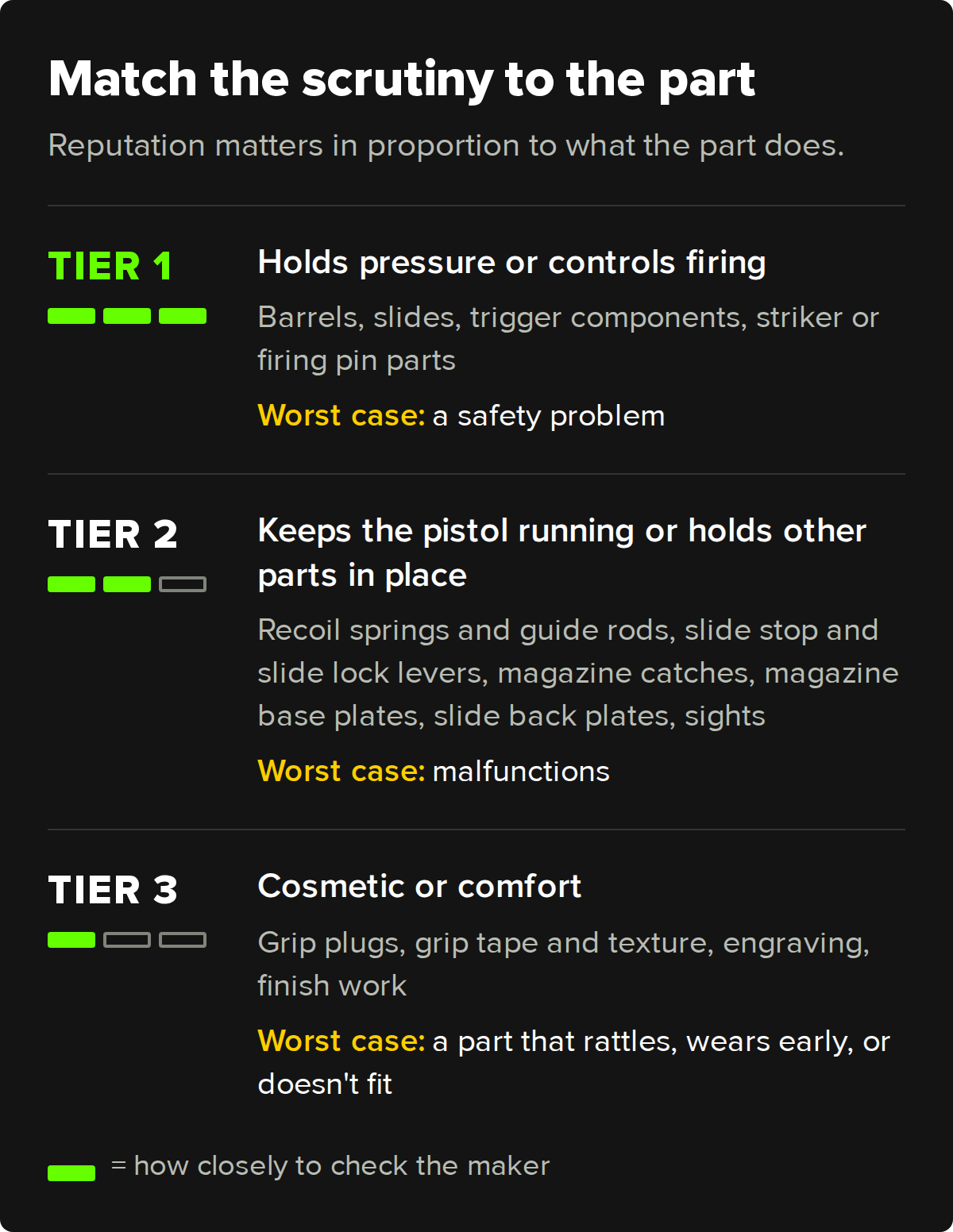
Reputation matters in proportion to what the part does. A barrel holds the pressure of every shot, and the slide closes the breech behind it. Under the ANSI/SAAMI pressure standard, the maximum average pressure for 9mm Luger is 35,000 psi.1 A grip plug never sees any of that. They don’t deserve the same scrutiny, so sort parts into three tiers and raise the bar as you move up:
- Tier 1, holds pressure or controls firing: barrels, slides, trigger components, and striker or firing pin parts. A bad part here is a safety problem, so hold these makers to the highest bar.
- Tier 2, keeps the pistol running or holds other parts in place: recoil springs and guide rods, slide stop and slide lock levers, magazine catches, magazine base plates, slide back plates, and sights. A bad part here causes malfunctions, like a base plate that lets go and releases the magazine spring.
- Tier 3, cosmetic or comfort: grip plugs, grip tape and texture, engraving, and other finish work. The worst realistic outcome is a part that rattles, wears early, or doesn’t fit.
The trap is spending your research where it matters least. It’s easy to compare twenty grip plugs for a week and then buy a barrel on price. Flip that.
The six checks, and how much each one counts
These are the six checks we’d apply to any maker, ours included.* The weights are our judgment of how much each one tells you about a company before you’ve held its parts. The scoring section further down turns them into a total out of 100.
| Check | Weight | What a 5 looks like | What a 0 looks like |
|---|---|---|---|
| 1. Warranty terms | 20 | Published terms, exclusions, claim process, return window | No terms anywhere |
| 2. Origin and materials | 20 | Origin and a named material on every product | No origin, generic materials |
| 3. Fitment data | 20 | Models, generations, exclusions, and fitting notes | “Universal,” or model names only |
| 4. Track record | 15 | Long history, problems handled in public | No About page, no history |
| 5. Independent reviews | 15 | Several independent reviews with consistent findings | Reviews only on its own site |
| 6. Reachable support | 10 | Phone or email with hours, an address, install guides | Contact form only |
1. A warranty you can actually read (20 points)
A “lifetime warranty” badge is marketing. The terms page is the warranty. Federal warranty law sorts written warranties into two labels, “full” and “limited.”2 A limited warranty isn’t a red flag by itself. It means there are conditions, and the conditions are where you find out what you’re buying.
“Lifetime” needs a second question: whose lifetime? The FTC’s advertising guides say a lifetime claim should disclose “the life to which the representation refers.”3 It could be the original buyer, the pistol, or the part itself, and those are very different promises.
What earns full marks:
- Terms you can read before you buy, not only on the packaging
- Clear exclusions, such as wear items, finish wear, or installation damage
- A claim process: who to contact, who pays shipping, what proof you need
- A return window for parts that don’t fit
Your pistol’s own warranty matters too. Glock’s FAQ says “The WARRANTY may be voided if your GLOCK pistol or any of its parts are altered or modified from their original state.”4 Keep your factory parts in a labeled bag so you can return the pistol to stock, and tell any service center what you changed.
2. Where it’s made, and from exactly what (20 points)
“Made in USA” is a legal claim, not a mood. Under the FTC’s labeling rule, it requires final assembly and all significant processing in the United States, and that “all or virtually all ingredients or components of the product are made and sourced in the United States.”5 A maker that uses the phrase loosely gives you a reason to doubt the other claims on the page.
Watch for the softer phrases. “Designed in,” “engineered in,” and “American owned” say nothing about where the part was machined.
Materials should be specific enough to check. “Stainless steel” is a category; a named alloy grade is a spec. A maker that names the coating, and says whether a part is heat treated where that matters, is betting you’ll check. Vague material language on a Tier 1 part is a reason to keep looking.
3. Fitment data down to the generation (20 points)
“Fits Glock 19” is an incomplete sentence. The same model number can take different parts depending on its generation, and slim-frame models often take their own. Our slide lock lever compatibility guide and guide rod compatibility guide show how much fitment can shift within one family of pistols.
A reputable listing tells you:
- The exact models and generations it fits
- What it does not fit, stated outright
- Whether it drops in or may need fitting by a gunsmith
- Any other parts it requires or replaces
Treat “universal” or “fits all generations” on a slide, barrel, or trigger part as unproven until the maker shows you the list.
4. A track record, including the mistakes (15 points)
Years in business count, but they aren’t the whole story. Even a good maker can ship a bad batch. The reputable ones say so publicly. A recall or safety notice on their own site, with a clear remedy, is a point in their favor, not against them.
Check the About page for when the company started and who runs it. Then search the company name with “recall” and “safety notice,” and read what comes back from sources other than the company.
5. Reviews you didn’t read on the seller’s site (15 points)
Reviews on a product page sit on a site the seller controls, even when every one of them is honest. Look for reviews somewhere the maker doesn’t control, written by someone who installed the part, that name the pistol and generation and, ideally, how many rounds the part has run. If a maker claims a professional shooter or team runs its parts, the shooter’s own sponsor list should say so too.
A maker with no independent footprint isn’t necessarily bad. It’s unproven, and Tier 1 parts are the wrong place to prove it.
6. A person who answers (10 points)
Before you buy a Tier 1 part, send the maker a fitment question by email or phone. How fast and how specifically they answer tells you a lot, and it costs nothing. Full marks go to a phone number or monitored email with published hours, a physical business address, and installation instructions or videos for the part you’re buying.
Red flags that end the search
- Anything sold to make a pistol fully automatic. Federal law treats “any part designed and intended solely and exclusively, or combination of parts designed and intended, for use in converting a weapon into a machinegun” as a machinegun,6 and makes it unlawful “for any person to transfer or possess a machinegun,” with narrow exceptions.7 Glock’s FAQ calls these conversion devices illegal and says the company doesn’t make, license, or sell them.4 A seller offering one isn’t a parts maker to trust with anything.
- No published warranty terms. A badge with no page behind it.
- “Universal” fitment on slides, barrels, or triggers with no model and generation list.
- No way to reach a person. A contact form, no address, no phone.
- Origin claims that dodge the question, like “designed in the USA” with nothing about where the part is made.
- Prices that don’t add up for the material and machining claimed on a Tier 1 part.
- Product photos that also appear on other sellers’ listings. A reverse image search takes seconds.
Score a maker yourself
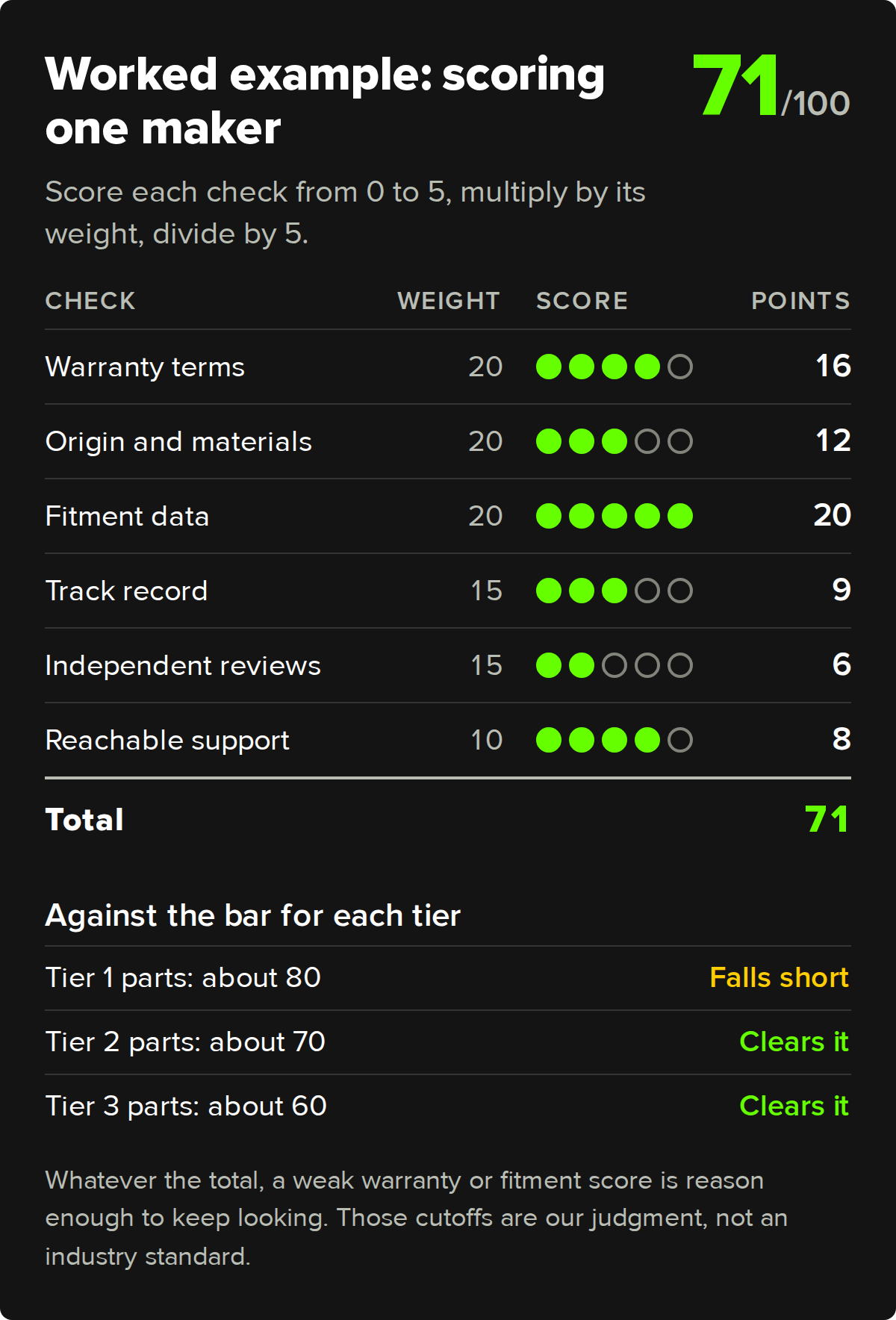
Score each check from 0 to 5 using the table above, multiply by its weight, divide by 5, and add the six results for a total out of 100. A maker that scores 4, 3, 5, 3, 2, and 4 lands at 71: fine for a grip plug, short of the bar for a barrel.
Our rule of thumb: look for a total of about 80 or higher for Tier 1 parts, about 70 for Tier 2, and about 60 for Tier 3. Whatever the total, a weak warranty or fitment score is reason enough to keep looking. Those cutoffs are our judgment, not an industry standard.
Before you install anything
- Read the maker’s installation instructions and your pistol’s manual before you start.
- Point the pistol in a safe direction with your finger off the trigger. Remove the magazine first, then lock the slide back and visually and physically confirm the chamber and magazine well are empty. Keep ammunition out of the room while you work.
- Wear eye protection. Springs and small parts can launch during disassembly.
- After installing any Tier 1 or Tier 2 part, run a function check before live fire. Your pistol’s manual or a qualified armorer can walk you through it.
- If you’re not sure, have a qualified gunsmith or armorer do the install. Trigger and striker work is where that matters most.
- Check your state’s rules on buying and shipping parts. If you’re in California, read up on AB 1263’s requirements for parts shipments before you order.
Frequently asked questions
Check six things: published warranty terms, origin and materials, fitment down to the generation, track record, independent reviews, and reachable support. Apply the strictest standard to barrels, slides, and trigger parts.
They can. Glock’s FAQ says the warranty may be voided if the pistol or its parts are altered or modified from their original state. Keep your factory parts so you can return the pistol to stock, and tell any service center what you changed.
It’s a legal claim about where, not how well. The FTC’s rule requires all or virtually all components to be made and sourced in the United States. Pair it with a named material and finish before you trust it.
Barrels, which hold the pressure of every shot (35,000 psi maximum average for 9mm Luger under the ANSI/SAAMI standard); slides, which close the breech; and trigger and striker parts, which decide when the pistol fires.
No, outside narrow exceptions. Federal law treats a part designed and intended solely and exclusively for converting a weapon into a machinegun as a machinegun, and possessing one is unlawful except in limited cases. Avoid any seller that offers them.
Notes and sources
* This guide is published by NDZ Performance, which designs and makes pistol aftermarket parts and also sells parts from other manufacturers. These checks apply to every maker, including us. Shop NDZ Performance.
- SAAMI, ANSI/SAAMI Z299.3-2022, centerfire pistol and revolver ammunition, pressure table (MAP in psi/100: 9mm Luger 350)
- 15 U.S.C. § 2303, designation of written warranties
- 16 CFR § 239.4, “Lifetime” and similar representations
- GLOCK, frequently asked questions
- 16 CFR § 323.2, Made in USA labeling rule
- 26 U.S.C. § 5845, definitions
- 18 U.S.C. § 922(o), unlawful acts