A friend looked at your pistol and said you should drop a “solid metal” Glock 19 guide rod in it. Maybe your factory rod cracked, or maybe it just came up in passing. Either way, you are now standing where a lot of new owners stand: not sure if this is a real upgrade, a waste of money, or something that could mess up a gun that runs fine right now.
Here is the honest version. We make these rods, so we will tell you exactly what one does, what it does not do, and when a steel rod is the right call for a Gen 5 Glock 19. Sometimes the answer is yes and we will show you why. Other times it is save your money, and we will tell you which is which.
The short answer on a Glock 19 guide rod
For a Gen 5 Glock 19, a steel Glock 19 guide rod is a durability and serviceability upgrade. It is not a recoil cure. If your factory polymer rod has cracked, a solid stainless rod is a smart, lasting fix.
If your gun runs fine and you only want softer recoil, think twice. The felt difference on a 9mm this size stays subtle, and that money is better spent on ammo. One rule matters more than the metal: match the recoil spring weight to your gun. The spring, not the rod, is what changes how the pistol cycles.
What a Glock 19 guide rod actually does
Inside the front of your pistol, under the barrel, a spring wraps around a thin rod. That rod is the Glock 19 guide rod, and the spring around it is the recoil spring. Together, people call it the recoil spring assembly.
Its job is simple. When you fire, the slide slams backward, ejects the empty case, and picks up the next round. The recoil spring soaks up that rearward energy and pushes the slide forward into battery, which just means the slide is fully closed, locked up, and ready to fire. The guide rod is the track the spring rides on, so it compresses straight and does not kink or bunch up.
That is the whole job. It is not a recoil eliminator, and it is not a precision part the way a barrel is. It keeps the spring aligned and gives it something to push against. A pistol with a worn or wrong setup will short stroke, fail to return fully to battery, or throw brass strangely. A pistol with a good one just cycles, and you never think about it.
What “my guide rod failed” usually means
On a Glock, the factory guide rod is polymer, not metal. The recoil spring on a Gen 5 Glock 19 is a captured dual spring assembly, meaning the rod and the two nested springs come as one sealed unit that you do not take apart. It is marked 1-7-1 from the factory.
Polymer is light and cheap to make, and it works fine for a long time. It is also the part of the assembly most likely to show wear, because it is plastic riding against metal under repeated impact. When people say their guide rod failed, it is almost always one of these:
- The polymer rod has visibly chipped, cracked, or splintered, usually near the flat plate end that sits against the front of the frame.
- The spring has lost tension over a high round count, so the slide feels sluggish returning to battery, or you start getting light strikes and stovepipes.
- The whole captured unit has gone soft enough that the gun runs dirty or throws brass inconsistently.
One thing is worth being clear about. A true cracked-rod failure is not the most common thing that happens to a Glock. Far more often it is the spring wearing out, not the rod snapping. Polymer rods can and do crack, though, and when they do, that is a real reason to replace the assembly.
How to confirm it before you spend a dime
Field strip the pistol. With the slide off and pointing in a safe direction, lift the recoil spring assembly out of the slide and look at the rod. You are checking for:
- Cracks or chips in the plastic, especially at the flat end.
- A spring that is visibly shorter than it used to be, or coils that look bound up or kinked.
- Any grinding, gritty feel, or binding when you press the assembly closed against a bench with your hand.
If the rod is clean and intact and the gun runs fine, nothing failed and you do not need anything. Do not let a part swap become a solution looking for a problem. If the rod is cracked, or your round count is high and the gun has started misbehaving, you have a real reason to replace it. Now the question of material matters.
Factory vs. solid steel vs. tungsten: what actually changes
Here is where most articles either oversell metal rods or dismiss them. Neither move is honest. Let us go mechanism by mechanism.
Weight, and where it sits
A polymer factory rod is very light. A stainless steel rod is heavier, and a tungsten rod is heavier still, because tungsten is one of the densest metals you can machine, so you get more weight in the same small space.
Put real numbers on it. A stock Gen 5 Glock 19 recoil spring assembly weighs around 0.7 ounce. Our stainless heavyweight assembly for the same gun comes in around 1.44 ounces. That is more than double the weight of the rod itself.
That weight sits low and forward, right under the barrel near the muzzle, which is exactly where weight does the most to resist the muzzle rising. So the question is not whether a heavier rod adds weight up front. It does. The real question is how much that matters on a pistol that already weighs close to two pounds loaded, and whether you will feel it.
What a heavier rod does in the firing cycle
When the gun fires, the muzzle wants to climb. The bore sits above your hand, and the recoil pushes back through a line above your grip. Extra mass out front gives that climbing motion more to fight against, so in theory the muzzle returns to point of aim a hair faster between shots.
That mechanism is real. It is the same reason a heavier gun is easier to shoot fast than a light one. But doubling the rod only adds a fraction of an ounce to the whole gun, and on a 9mm Glock 19, which is already a low-recoil gun, the felt difference from rod material alone is subtle. Some shooters notice it. Many honestly cannot tell in a blind comparison. We are not going to tell you it transforms the gun, because it does not.
What it does not do
A heavier guide rod does not make the pistol more accurate. Accuracy comes from the barrel, the lockup, the sights, and you. Nothing about rod material changes where the bullet goes.
It also does not reduce recoil in the sense of less energy hitting your hand. The energy of the cartridge is fixed. The gun can move slightly differently while delivering that energy, but that is a feel and follow-up-speed thing, not a drop in recoil force. Anyone selling you a guide rod as a recoil reducer with a percentage on it is reading marketing, not physics.
Captured vs. non-captured: the part nobody explains
This is the difference that actually matters for a Glock, and almost no one tells beginners about it.
The factory Gen 5 unit is captured. The rod and springs are one sealed piece, so when the spring wears out, you throw the whole thing away and buy a new sealed unit.
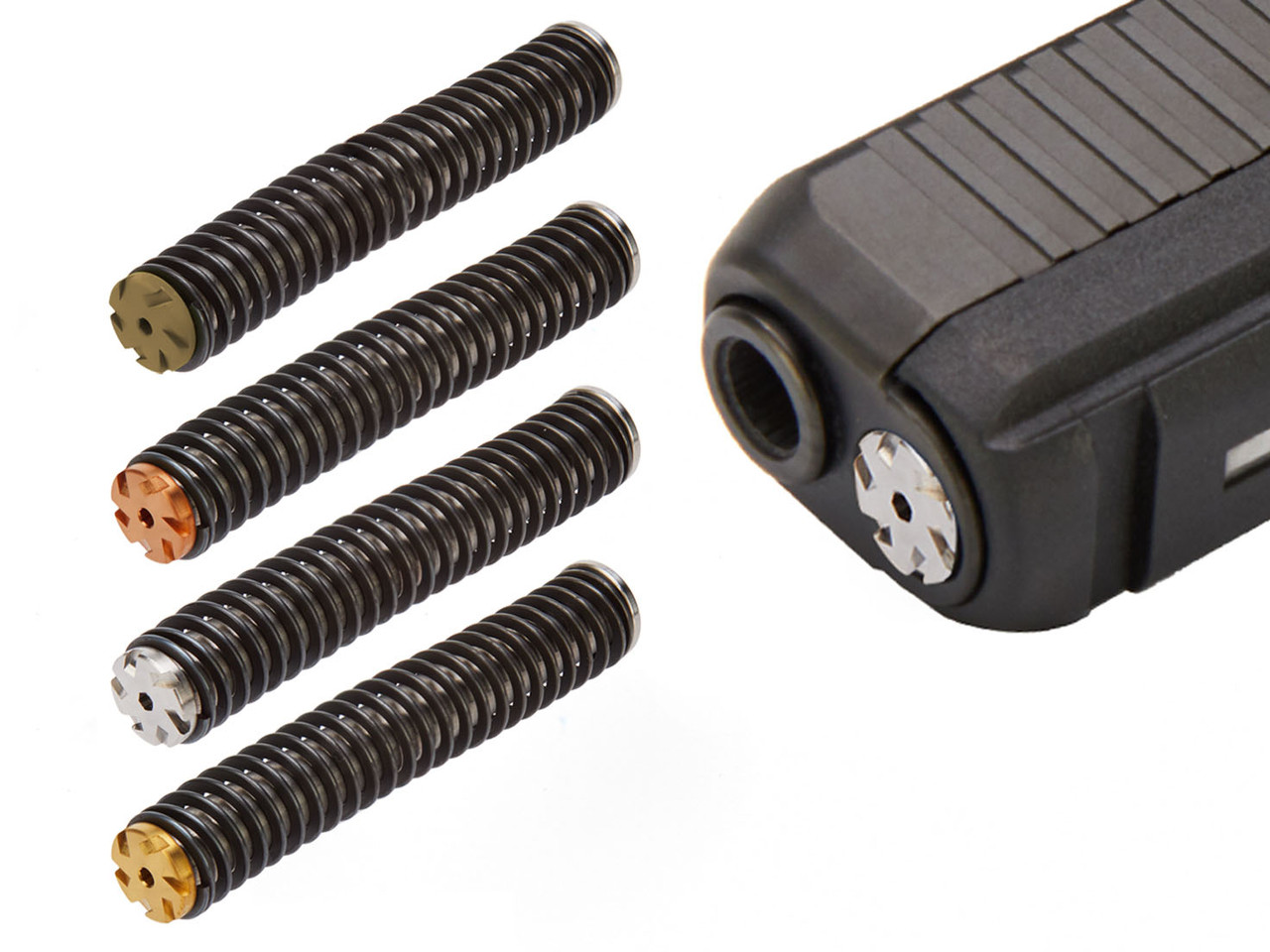
Most quality steel rods are non-captured. The steel rod is one piece, and the recoil spring is a separate part held on by a small removable tip. Our Glock 19 Gen 5 heavyweight guide rod uses a hex screw tip for exactly this reason.
The advantage is serviceability. When the spring fatigues after a few thousand rounds, you replace just the spring on the same rod and skip buying the entire assembly again. Over the life of the gun, that is the genuinely practical upside of a metal rod, more than any recoil claim.
The spring is the variable that matters
Read this part twice, because it is where people get into trouble.
The rod material almost never changes how your gun cycles. The spring weight does. Buy a metal rod with a spring heavier or lighter than your gun was designed around and you can cause real problems: failure to return fully to battery, a slide that does not cycle enough to feed reliably, or brass that ejects weakly. None of that is the metal’s fault. It is the spring rate.
This is also where a non-captured rod earns its keep. Our assemblies run ISMI recoil springs in weights from 13 to 22 pounds, so you can match the spring to your load instead of guessing. For a stock Gen 5 Glock 19 shooting normal range and defensive ammo, you want a standard-equivalent weight. You only step heavier or lighter for a specific reason, like a compensator or a light competition load.
If you want to dial it in yourself, a guide rod tuner pack ships several spring weights, so you can test rather than commit blind. Match the spring to the gun, and the rod material is just durability and feel.
Does a Gen 5 Glock 19 actually need a guide rod?
Here is the straight call for this specific platform. The Gen 5 Glock 19 is a 9mm service pistol that already runs and already shoots soft. Glock engineered it around its factory recoil spring assembly, and that assembly works. The honest breakdown looks like this:
- For recoil or muzzle control: marginal. This is a low-recoil gun to begin with, and the weight a rod adds is small next to the gun’s total weight. Do not buy a steel or tungsten rod for the Gen 5 Glock 19 expecting a noticeable softening of recoil. If that is your only reason, save your money.
- For durability after a failure: genuine. If your polymer rod has cracked or chipped, a one-piece stainless rod is a sound, lasting fix. Steel does not crack the way polymer can, so replacing a failed factory unit with a quality steel rod is a real upgrade here, not a sideways move.
- For serviceability: genuine. A non-captured steel rod lets you replace just the spring at its service interval instead of buying a whole sealed assembly every time. If you shoot a lot, that adds up.
- For feel and preference: real but personal. Some shooters like the slightly different balance of a weighted rod and a slightly different cycling feel. That is a legitimate reason to want one. It is a preference, though, and we will call it a preference, not a performance fix.
Here is where to be careful on this platform. The Gen 5 was built around its dual captured spring. Swap in an aftermarket rod with a spring weight that does not match what the gun expects, and you can introduce cycling problems the factory setup never had. The rod itself is not the risk. The wrong spring is. Buy a setup specified for the Gen 5 Glock 19, run an appropriate spring weight, and you avoid the whole problem.
Tungsten on this gun deserves the same honesty. Tungsten gets you more weight than steel in the same space, so if forward weight is the thing you are chasing, it does more of it. On a 9mm Glock 19, though, you are stacking a denser version of an already-small effect. For competition shooters chasing every last bit of flat tracking, that can be worth it. For a new owner asking whether they need it, the answer is no. A stainless heavyweight rod covers the reasons that actually apply to you.
How to verify exact fitment
This is the part that protects your money and your gun. Do not skip it.
A guide rod is a fitted part. It has to match your pistol’s make, model, generation, and sometimes the specific variant. A rod cut for one generation can be the wrong length or use the wrong end design for another, even within the same model name. Glock changed the recoil spring assembly design across generations, which is exactly why a Gen 5 Glock 19 takes a different unit than an older Gen 3.
For reference, our Gen 4 to Gen 5 guide rod assembly is cut to fit the Gen 5 Glock 19, 19X, 45, and 47, plus the Gen 4 Glock 19, 23, 32, and 38. It does not fit Gen 1 through 3 guns, which use a different design. That is the level of specificity you should see before you buy anything: exact models, exact generations, spelled out.
Treat “fits most 9mm” or “universal Glock” as a red flag. Those phrases mean the part was not cut for your specific gun. A guide rod that is close but not exact is the kind of part that causes the cycling problems we talked about. Exact fit is the standard, not a luxury. If a seller cannot tell you the exact model, generation, and variant their rod is for, that tells you how the part was made.
Now confirm your own gun before you buy. Your generation is usually marked on the pistol, and you can verify it by the features of your frame and the style of your factory recoil assembly. If you are not sure, match the part number on your factory assembly, or ask the seller to confirm against your generation. A maker who actually machines the part will know the answer immediately.
What we build, and why it is made the way it is
Since we machine these in-house, here is what actually goes into ours, in plain terms. We cut our Glock 19 Gen 5 guide rods from solid stainless steel on CNC machines in the USA. Solid stainless does two things polymer cannot: it does not crack under repeated slide impact, and it does not flex, so the spring rides true every cycle. The rod is non-captured with a hex screw removable tip, the feature that lets you change spring weights and replace a tired spring without replacing the rod.
We pair them with ISMI premium recoil springs. ISMI makes these from certified aerospace-specification alloy, then heat treats, shot peens, and stress relieves them, so they hold their rate instead of fading early. They come in 13, 15, 18, 20, and 22 pound weights, so you can match the spring to your gun and your load. Every NDZ guide rod carries a lifetime warranty against manufacturing defects. None of that is marketing language. It is just what the part is and why we made each choice.
So, should you do this?
Here is the short version, the kind you can act on:
- Your factory rod is intact and the gun runs fine: you do not need a steel guide rod. Not for recoil, not for accuracy. Spend the money on ammo and range time instead.
- Your polymer rod has cracked or chipped: yes, replace it. A quality one-piece stainless rod is a smart, durable choice that will not fail the same way.
- You are a high-volume or competition shooter: a non-captured steel rod is worth it, mostly for serviceability and a bit of forward weight, with the option to tune spring weight to your load.
- You just like the idea of a metal part in there: that is fine, it is your gun. Just match the spring weight and buy one cut exactly for the Gen 5 Glock 19, so you do not trade a non-problem for a real one.
Here is the thing to take away. The metal rod is a durability and serviceability upgrade with a small feel component, not a recoil cure. Buy it for the reasons that are real and you will be happy with it. Buy it expecting magic and you will not feel what you paid for.
See it installed
Installation is a standard Glock field strip and a swap of the recoil spring assembly. You need no tools beyond what you already use to clean the gun, and you make no permanent changes. Here is the full walk-through on our Gen 5 Glock 19 rod:
If you do need one
So you landed in the yes column. Maybe a cracked factory rod, a high round count, or you simply want the serviceability of a non-captured setup. That is exactly what a properly machined Glock 19 guide rod is for.
For most Gen 5 Glock 19 owners, the NDZ Glock 19 Gen 5 Heavyweight Guide Rod Assembly is the one to look at. If you want the standard-weight stainless assembly that also fits across the Gen 4 and Gen 5 family, check the Gen 4 to Gen 5 guide rod assembly. It covers more guns and ships with your choice of ISMI spring weight.
Either way, we make them rather than rebrand them, so we can tell you what your rod is, what spring it should run, and exactly which gun it fits. If you want the longer breakdown of what the heavyweight version changes, we wrote that up separately in our heavyweight guide rod guide. For the full platform-by-platform picture, see our pistol guide rod upgrade guide.
If your factory rod failed, or you want a serviceable rod that matches your gun exactly, that is the rod to look at. If your gun is running fine and nothing cracked, keep your money. We would rather you trust the next answer we give you than sell you a part you did not need.
Frequently asked questions
Does a steel guide rod reduce recoil on a Glock 19?
Not in the sense of less energy hitting your hand, since the cartridge energy is fixed. A heavier rod adds a small amount of weight low and forward, which can help the muzzle settle a touch faster between shots. On a 9mm Glock 19, that effect is subtle. Buy a steel rod for durability and serviceability, not as a recoil cure.
Will an aftermarket guide rod make my Glock unreliable?
The rod itself almost never changes reliability. The spring weight does. Run a spring that is too heavy or too light for your gun and ammo, and you can get failures to return to battery or weak ejection. Run a standard-equivalent spring weight in a rod cut for your exact model, and reliability stays where the factory had it.
How do I know if my factory guide rod is bad?
Field strip the pistol and inspect the recoil spring assembly. Look for cracks or chips in the polymer rod, a spring that has gone short or kinked, or any gritty binding when you compress it by hand. If it is intact and the gun runs fine, it is fine. If it is cracked, or your round count is high and the gun has started malfunctioning, replace it.
Does the NDZ Glock 19 Gen 5 guide rod fit other Glock models?
Our Gen 4 to Gen 5 assembly fits the Gen 5 Glock 19, 19X, 45, and 47, plus the Gen 4 Glock 19, 23, 32, and 38. It does not fit Gen 1 through 3 guns. Always confirm your model and generation against the listing before buying, because a guide rod is a fitted part and exact fit is the standard.