Pick up a Smith & Wesson SD9 VE, feel the plastic guide rod under the slide, and somebody at the range will tell you a solid metal one wakes the gun up. It sounds right. Heavier feels better, the factory parts on these budget S&W strikers are about as basic as it gets, and a steel SD9 VE guide rod is the easy first upgrade people reach for.
We machine guide rods in Cheshire, Connecticut, so this question lands on our counter a lot. The honest version is more useful than the range myth. A steel rod does a couple of real things and a few things people only imagine. Here is where the line is.
The short answer on a SD9 VE guide rod
If your factory plastic rod is intact and the gun runs, a steel SD9 VE guide rod is a durability and feel upgrade, not a performance one. It will not change how the slide cycles on its own. The recoil spring does that.
Where steel earns its keep on the SD9 VE and SD40 VE: the factory rod is polymer, and polymer rods can chip or crack over thousands of rounds. A solid stainless rod removes that failure point and adds a little weight up front. Worth doing if you shoot the gun hard or just want it to feel less cheap. Not worth doing if you are chasing recoil numbers.
What a SD9 VE guide rod actually does
The guide rod is the rail the recoil spring rides on. It keeps the spring straight and aligned as the slide travels back and returns to battery. That is the whole job. It does not store energy. It does not time the action.
On a polymer rod, the part can flex slightly under firing and, over time, wear or crack at the head. A steel SD9 VE guide rod does not flex and does not crack. The spring sits on a rigid, dimensionally stable surface for the life of the gun. That is the mechanical case for steel, and it holds up.
What “my guide rod failed” usually means
When a shooter says the guide rod failed, the rod itself is rarely the culprit. Nine times out of ten the symptom is a tired recoil spring: brass landing closer than it used to, the occasional failure to return fully to battery, or the slide not locking back on an empty magazine. Those are spring problems, not rod problems.
Confirm it before you spend
Pull the slide off your SD9 VE or SD40 VE and look at the assembly. If the polymer rod is cracked or the spring looks set or kinked, that is your answer. If the rod is fine and the gun simply feels softer than it did new, you need a fresh spring, and the rod material is a separate decision.
Factory polymer vs steel vs tungsten
Three materials come up. The factory part is polymer. The common upgrade is stainless steel. Tungsten gets mentioned for its density. They differ mostly in weight, and weight is the only variable the rod itself controls.
Weight
Polymer is the lightest. Stainless steel is heavier and sits low in the frame, right under the barrel. Tungsten is denser still, so a tungsten rod of the same size weighs more than steel. More mass at the muzzle end gives some shooters a flatter feel during the firing cycle. The SD9 VE and SD40 VE are full-size guns to begin with, so the felt change from added rod weight is modest, not dramatic.
The firing cycle
Here is the part the myth gets wrong. Swapping a polymer rod for steel does not change how fast the slide moves or how the gun returns to battery. The recoil spring sets the resistance and the timing. The rod is just the track. A heavier rod adds static mass to the gun, which a shooter may feel as a slightly steadier muzzle, but it is not retiming anything.
What it does not do
A steel guide rod does not make a SD9 VE more accurate. The barrel, the lockup, and the shooter do that. It does not soften recoil by any measurable amount on a gun this size. If a listing promises tighter groups from a rod swap, treat the claim as marketing and move on.
Captured vs non-captured
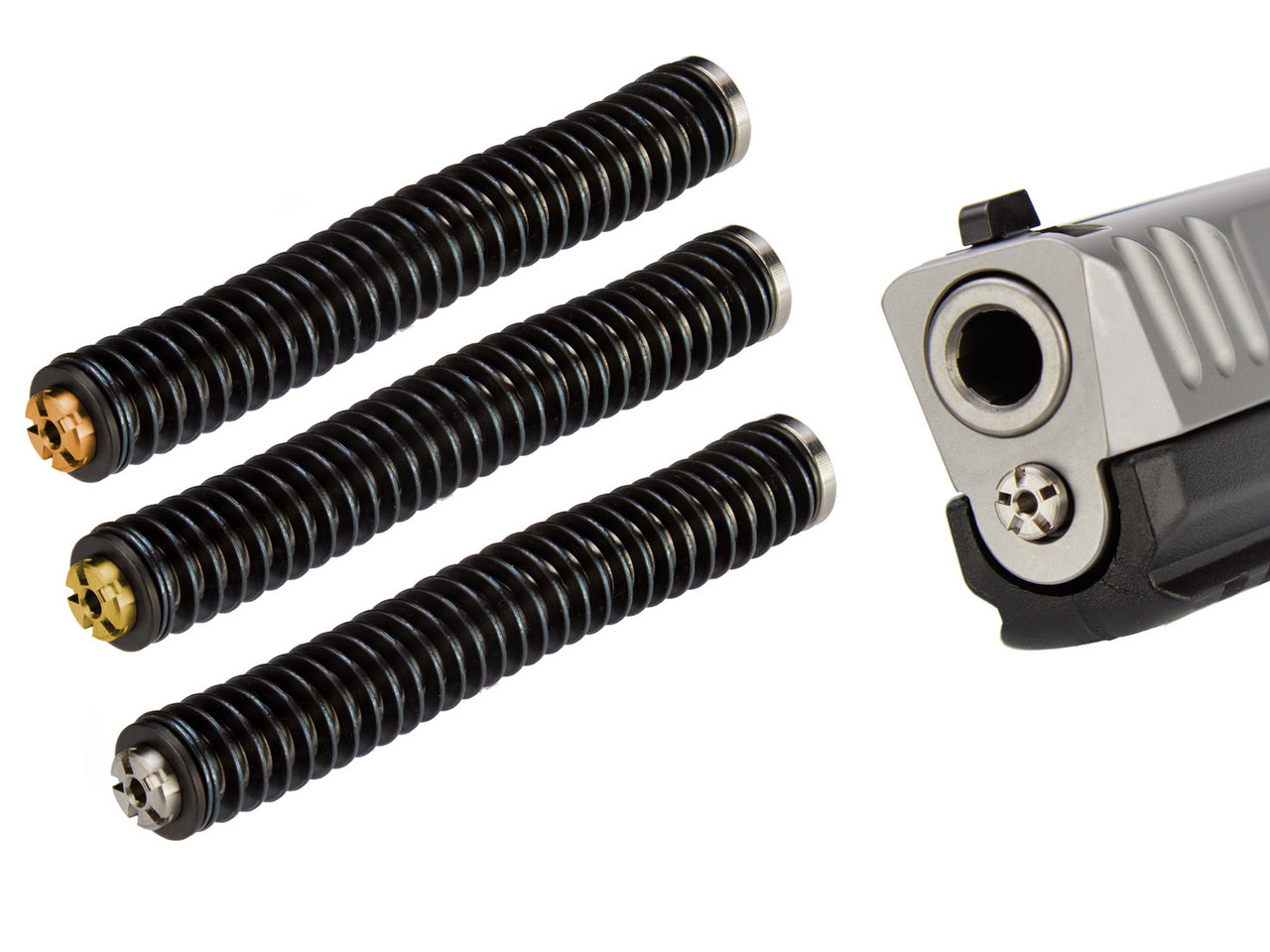
The factory assembly is captured, meaning the spring is fixed on the rod as one unit. A non-captured or removable-tip rod lets you take the spring off and swap weights. That flexibility is the practical reason to go aftermarket: you stop being locked into one spring rate. Our SD9 VE guide rod uses a hex-screw removable tip for exactly that.
The spring is the variable
This is the whole point. If you want to change how the SD9 VE or SD40 VE cycles, you change the spring weight, not the rod material. A lighter spring lets the slide cycle with reduced-power or reloaded ammo. A heavier spring slows the slide for hot loads. Material buys you durability and a little weight; the spring is what governs how the gun runs.
Does a Smith & Wesson SD9 VE and SD40 VE actually need one?
Honest verdict, by situation:
- Polymer rod cracked or worn: yes, replace it, and steel is the smart material to replace it with.
- You want to tune spring weight for different ammo: yes, a removable-tip steel rod gives you that.
- You shoot the gun a lot and want a part that will not fail: yes, durability is a real reason.
- You just want the gun to feel a touch more solid in the hand: sure, it does that.
- You expect less recoil or better accuracy: no, save your money. The rod will not deliver that.
One caution on spring weight. The SD40 VE is .40 S&W and the SD9 VE is 9mm, and the two cartridges recoil differently. The same kit fits both, but match the spring to your caliber and your load, not to a number a forum quoted. Going too heavy can short-stroke the slide and cause failures to lock back or feed. Going too light can batter the gun with stout loads. Start at or near the factory rate and only deviate with reason.
On tungsten: it is a legitimate material where you want maximum mass in a small space, which is why it shows up on subcompacts. We do not make a tungsten rod for the SD VE platform. For a full-size gun like this, the extra density buys very little real-world difference over good stainless, and stainless is the sensible choice here.
How to verify exact fitment
Fitment is where people waste money. The SD VE family looks similar to other S&W strikers but the guide rod is specific. Confirm your exact model before buying.
Our SD9 VE assembly is listed to fit these Smith & Wesson models:
- SD9
- SD9 2.0
- SD9 VE
- SD40
- SD40 VE
That covers both calibers, 9mm and .40. If a product page says only “fits most 9mm pistols” or lumps the SD line in with M&P or Sigma without naming your model, treat that as a red flag and confirm before you order. A guide rod that almost fits does not fit.
What we build, and why
We machine the NDZ SD9 VE guide rod from solid stainless steel in Cheshire, Connecticut. Solid stainless removes the flex you get from the factory plastic, and it will not chip or crack the way polymer rods are prone to do.
The hex-screw removable tip lets you change spring weights, so you can calibrate the gun to your ammunition. It ships with ISMI premium springs, manufactured from certified aerospace-specification alloys, in 15 lb, 18 lb, and 20 lb. The 15 lb is the lighter option for reduced-power or reloaded ammo. A tuner pack with all weights is available if you want to dial it in across loads.
Every NDZ part carries a lifetime warranty against manufacturing defects, and it is made in the USA. That is the part we can stand behind, because we cut it ourselves.
So, should you do this?
Quick decision path:
- Check your factory rod first. Cracked or worn means replace.
- If you want to tune for different ammo, get a removable-tip steel rod with multiple springs.
- Match the spring to your caliber and load before you change anything else.
- Do not buy expecting recoil reduction or accuracy gains. Buy for durability and tuning.
If you do need one
When the rod is the right call, our NDZ Smith & Wesson SD9 VE guide rod assembly is the solid-stainless, removable-tip version with the ISMI spring set. If you are still weighing the broader question, our pistol guide rod upgrade guide walks through the mechanics across platforms, and the Glock 19 version of this question covers the same logic on a different gun.
Frequently asked questions
Will a steel SD9 VE guide rod reduce recoil?
Not in any way you can measure. The added mass may make the gun feel slightly steadier, but recoil is governed by the load and the spring, not the rod material. On a full-size gun the difference is subtle at most.
Does the same guide rod fit both the SD9 VE and SD40 VE?
Yes. The assembly fits the SD9, SD9 2.0, SD9 VE, SD40, and SD40 VE. The platform is shared across the 9mm and .40 models. Match the spring weight to your caliber and ammo.
What spring weight should I run?
Start near the factory rate for your ammo and adjust only with reason. The 15 lb suits reduced-power or reloaded ammo. Heavier springs slow the slide for hot loads. Too heavy can keep the slide from locking back or feeding, so do not over-spring a 9mm chasing a softer feel.
Is a captured or non-captured rod better for the SD VE?
For most owners, a non-captured rod with a removable tip is the better buy because you can swap spring weights. The factory captured unit locks you into one rate. If you never plan to change ammo type, either works, but the removable tip costs you nothing in durability.