
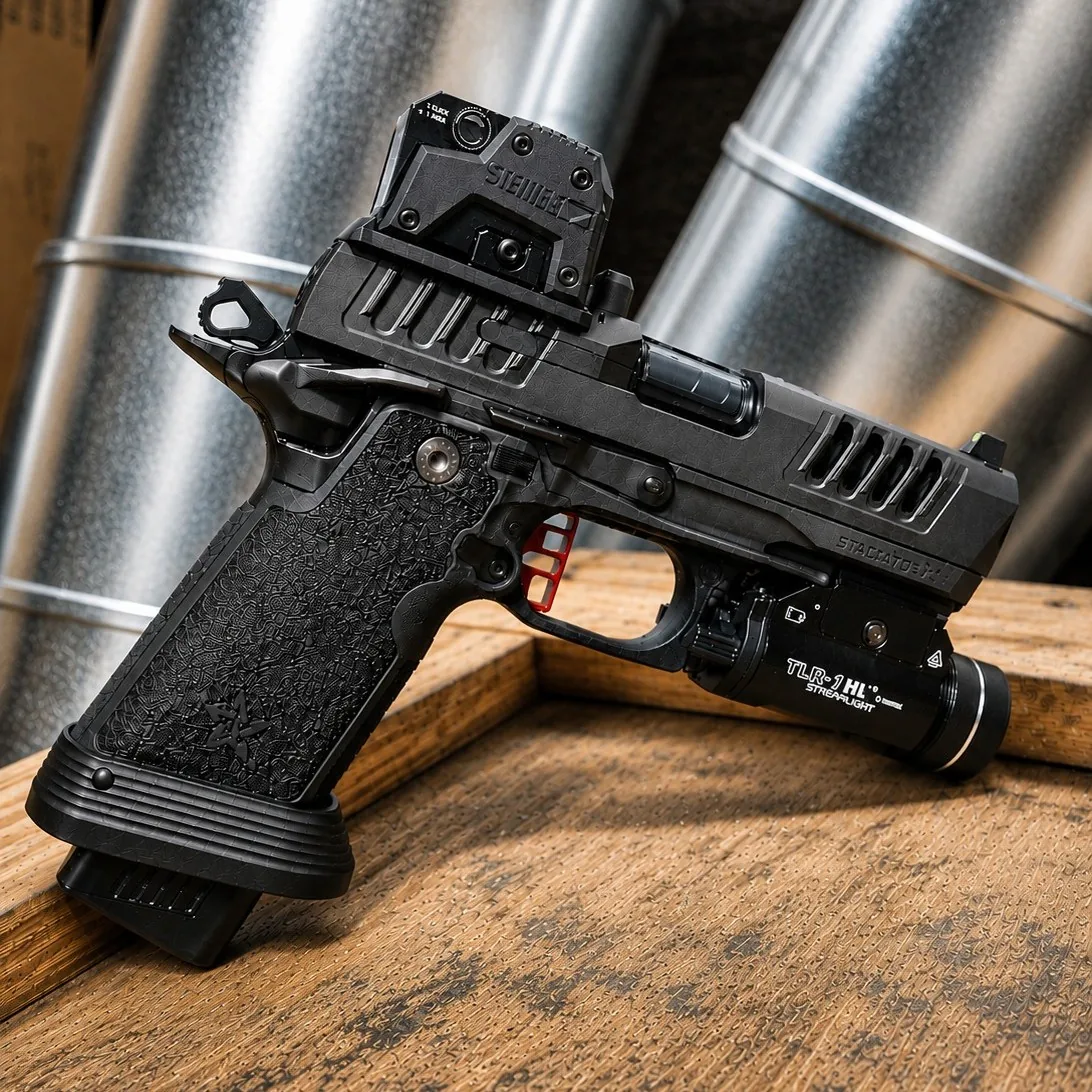
The SIG P211 GTO vs Staccato HD P4 decision comes down to two very different answers to the same problem. For thirty years, if you wanted a double-stack 1911, you bought a 2011 built around a proprietary steel-and-polymer grip and $70 magazines. In 2025, however, two of the biggest names in handguns each decided that formula needed fixing, and they fixed it in opposite directions. SIG’s answer is the P211-GTO. Staccato’s answer is the HD line, and the HD P4 is the model most people cross-shop against the GTO. Below, this guide puts the P211 GTO vs Staccato HD P4 side by side on the numbers that matter: weight, size, capacity, magazine cost, trigger, optics, safeties, and what each one is built to do.
Last updated: August 2026
SIG P211 GTO vs Staccato HD P4: Spec Comparison Table
| Spec | SIG P211-GTO | Staccato HD P4 |
|---|---|---|
| Caliber | 9mm | 9mm |
| Barrel | 4.4″ bull barrel, non-threaded, Mach3D compensator | 4.0″ bull barrel (stainless or DLC), no comp |
| Overall length | 8.5″ | 7.6″ |
| Height | 5.25″ | 5.6″ |
| Width | 1.5″ | 1.6″ (grip 1.2″) |
| Weight (unloaded) | 45.9 oz | 32 oz |
| Frame | Stainless steel mainframe, full-length dustcover with machined rail | Billet 4140 steel frame |
| Grip module | Aluminum alloy with removable Hogue G10 panels, removable magwell | Polymer with TAC texture, integrated magwell |
| Magazine pattern | SIG P320 | Glock 17 (G17/G47 pattern) |
| Capacity as shipped | 21+1 (two 21-rd flush, one 23-rd extended) | 18+1 (two 18-rd Mec-Gar steel) |
| Action | Single-action only | Single-action only |
| Trigger | Flat skeletonized, 3.5–4 lb advertised | Curved aluminum, 4–4.5 lb |
| Grip safety | Yes (plus firing-pin safety, Series 80-style) | No (firing-pin block instead) |
| Thumb safety | Ambidextrous | Ambidextrous |
| Optic mount | SIG-LOC PRO cut | HOST direct-mount system |
| Sights | Fiber-optic front, blacked-out serrated rear (XRAY3 co-witness on optic model) | Ameriglo blacked-out (Core); Trijicon tritium front (Preferred/Premium) |
| Recoil system | Conventional guide rod | Captured 4″ flat-wire recoil system |
| MSRP | $2,399 / $2,799 with Romeo-X | $2,499 (Core) to $2,999 (Premium) |
What Is the SIG P211-GTO?
To begin with, the P211-GTO is SIG Sauer’s first 2011-pattern pistol, announced in 2025. It is a hybrid design: a stainless-steel mainframe with a full-length dustcover and a machined-in accessory rail sits on top of an aluminum alloy grip module. The grip module takes removable panels (Hogue G10 comes on the gun); likewise, the magwell comes off if you want a slimmer profile.
Above all, three things set the GTO apart from every other factory 2011. First, it feeds from SIG P320 magazines rather than 2011 magazines, and it ships with two 21-round flush mags and one 23-round extended mag. Second, the 4.4-inch bull barrel also wears SIG’s Mach3D compensator, a 3D-printed muzzle device that SIG says cuts muzzle rise by 30 percent. It attaches with a taper pin and a spring-loaded detent, so it comes off without tools. Third, the slide is cut for the SIG-LOC PRO footprint, and the $2,799 version ships with a Romeo-X SIG-LOC PRO red dot already mounted and co-witnessed with XRAY3 iron sights.
Equally important, it is a traditional 1911 in the ways that count for safety: single-action only, an ambidextrous thumb safety, a grip safety, and a firing-pin safety. RECOIL measured the trigger at just under four pounds, right where SIG advertises it. Everything is Nitron-finished, and the whole package weighs 45.9 ounces empty. That is a heavy handgun, and that weight is doing work.
What Is the Staccato HD P4?
Staccato built its reputation on the P, C2 and XC, all classic 2011s running Staccato’s own magazines. The HD line, launched in 2025, is therefore a clean-sheet redesign of the grip and magazine system. The HD P4 is the mid-size, four-inch model in that line, and the one that lines up most directly against the GTO. Its siblings are the HD P4.5 (longer barrel, front sight block, $2,699), the compact HD C3.6, and the compensated HD C4X that Staccato added at SHOT Show 2026 starting at $3,499.
Most importantly, the headline change is magazines: the HD P4 runs Glock 17-pattern magazines. It ships with two 18-round heat-treated steel Mec-Gar mags, and standard 17-round Glock magazines work too. Staccato paired that with a billet 4140 steel frame, a polymer grip module with an aggressive TAC texture and an integrated magwell, and a new captured 4-inch flat-wire recoil system.
In addition, Staccato deleted the grip safety. In its place is an active firing-pin block, and the beavertail is shaped so you can get higher on the gun. The slide uses Staccato’s HOST mounting system, which takes an RMR-footprint optic directly with no adapter plate. Sights depend on the package: the $2,499 Core gets Ameriglo blacked-out irons, while Preferred and Premium (up to $2,999) add a Trijicon tritium front sight. Trigger pull is a curved aluminum single-action at 4 to 4.5 pounds. Unloaded weight is 32 ounces.
P211 GTO vs Staccato HD P4 for Concealed Carry: Which Is Better?
In the P211 GTO vs Staccato HD P4 carry debate, the HD P4 wins, and it is not close. At 32 ounces and 7.6 inches long it is in the same weight class as a Glock 34 and shorter than one. Staccato designed it as an everyday-carry 2011, and the missing grip safety, the higher beavertail and the flat-wire recoil system all point at a gun meant to be drawn from a holster and shot fast from a less-than-perfect grip.
Meanwhile, the GTO is 8.5 inches long and 46 ounces before you load 22 rounds into it. It carries like a full-size steel 1911 with a compensator, because that is what it is. Plenty of people carry Government-length 1911s, so it can be done; even so, the GTO was not built around that job. If concealed carry is the primary mission, the HD P4 wins on weight, length and holster availability, and Staccato’s compact HD C3.6 pushes further in that direction if four inches is still too much gun.
P211 GTO vs Staccato HD P4 on the Range: Which Shoots Softer?
The GTO’s weight and compensator
First of all, fourteen extra ounces of steel plus a compensator is a lot of recoil mitigation. RECOIL’s review found the Mach3D comp made a distinct difference even with lightweight practice ammunition, and the reviewer’s summary was that the gun “doesn’t move when you do it.” A full-length steel dustcover, a bull barrel and a comp are exactly the recipe competitive shooters have been building 2011s to for decades. The GTO gives you that recipe from the factory for $2,399.
The HD P4’s recoil system and grip
By contrast, the HD P4 has no comp and no extra mass to lean on, so Staccato attacked recoil with geometry instead: the captured flat-wire spring, the higher grip position the beavertail allows, and a slimmer 1.2-inch grip that most hands can lock down on. It is a soft-shooting 32-ounce gun. It is not going to sit as flat as a 46-ounce compensated gun, and Staccato knows it, which is why the compensated HD C4X now exists at a $1,000 premium.
In short, for pure range and match work where weight is a feature, the GTO has the edge in the P211 GTO vs Staccato HD P4 matchup. If you shoot the same gun you carry, however, the HD P4 is the more honest all-rounder.
P211 GTO vs Staccato HD Magazines: P320 Mags or Glock Mags?
This is the decision that will actually settle P211 GTO vs Staccato HD for a lot of buyers, because both guns exist to get you off $70 2011 magazines. They just chose different donors.
The GTO runs P320 magazines. Capacity, above all, is the payoff: 21 rounds flush, 23 extended, and SIG offers 10-round mags for restricted states. Consequently, if you already own a P320 or M17/M18, every magazine in your range bag feeds the GTO. If you don’t, P320 mags are still widely stocked and reasonably priced, though not as cheap or as universal as Glock mags. One caution from the review pool: an aftermarket 30-round P320 magazine gave one reviewer trouble, while every factory mag ran clean. Stick with SIG-pattern mags you trust.
The HD P4 runs Glock 17-pattern magazines, the most common, cheapest and most widely upgraded 9mm pistol magazine made (our Glock magazine compatibility guide covers which factory mags interchange). Capacity as shipped is 18 with the Mec-Gar mags, or 17 with OEM Glock mags. That is three to four rounds fewer than the GTO per magazine; on the other hand, reloads are cheap and the aftermarket for Glock magazines is enormous. If you run OEM Glock 17 mags in an HD P4, our NDZ Glock Gen 1-5 extra-thick magazine floor plate is a drop-in swap for the plastic OEM plate: heavier aluminum with a larger grip area, which is exactly what you want on a magazine that has to clear the HD’s integrated magwell. For fitment by generation, see our Glock magazine plate compatibility guide.
Verdict: the GTO wins on rounds per magazine, whereas the HD P4 wins on magazine cost and availability. Own P320s? GTO. Own Glocks? HD P4. Own neither? The Glock ecosystem is the safer long-term bet.
How Do the Triggers and Safeties Compare?
Both are single-action-only 1911-style triggers, and both are good out of the box. Specifically, the GTO’s flat skeletonized trigger measures a hair under four pounds with a short 1.6mm reset. The HD P4’s curved aluminum trigger is advertised at four to four and a half pounds. The GTO’s is lighter on paper; in practice, the difference on the range is small.
Where they genuinely diverge, however, is the safety architecture. The GTO keeps the full 1911 set: thumb safety, grip safety and a firing-pin safety. That is a Series 80-style system, and it caps how far a gunsmith can tune the trigger. The HD P4 drops the grip safety entirely and relies on the firing-pin block plus the thumb safety. Some shooters see that as one less thing to fail under a bad grip; traditionalists, conversely, see it as one fewer layer. Note the one recurring criticism of the HD P4 in early reviews: the thumb safety can be nudged on unintentionally if your grip drifts off a textbook 1911 hold. Neither gun’s magazine release is truly ambidextrous, although the GTO’s is reversible.
SIG-LOC PRO vs HOST: Which Optic Mount Is Better?
Both companies ditched adapter plates. As a result, mounting is simpler on either gun. SIG’s SIG-LOC PRO cut mounts the Romeo-X low enough to co-witness with standard-height irons, and per RECOIL it also accepts DeltaPoint Pro and RMR-footprint optics. Staccato’s HOST system takes RMR-footprint optics directly. If you already own an RMR-pattern dot, either gun takes it, and our pistol optics installation guide covers mounting and zeroing. If you want the factory-integrated experience, SIG will sell you the GTO with the Romeo-X already zeroed on the slide for a $400 premium; Staccato sells the HD P4 optic-ready and lets you choose.
P211 GTO vs Staccato HD P4 Price: Which 2011 Costs Less to Own?
On price, P211 GTO vs Staccato HD P4 is close: $2,399 for the base GTO against $2,499 for the Core HD P4. The gap widens with options, though. The optic-equipped GTO is $2,799 all-in with a factory dot and co-witness irons. A Premium HD P4 is $2,999 before you buy an optic. On magazines, similarly, the HD P4 is cheaper to feed for the life of the gun. On aftermarket parts, the HD P4 benefits from Staccato’s head start and the Glock magazine ecosystem, while the GTO’s aftermarket is still catching up to traditional 2011s. If you own the SIG, therefore, budget for a slower parts pipeline in year one.
One place the GTO aftermarket is already moving, for example, is magazine baseplates. Our SIG P211 extended magazine plates replace the factory floor plate on the GTO’s P320-pattern mags in aluminum or heavyweight brass, and the brass version adds drop-free weight for reloads through the GTO’s magwell.
SIG P211 GTO vs Staccato HD P4: Which One Should You Buy?
- Buy the P211-GTO if: you want a range, match or home-defense 2011 that shoots as flat as possible from the factory, you value 21 to 23 rounds per magazine, you already own P320 magazines, or you want a factory-mounted, co-witnessed optic without doing the work yourself.
- Buy the Staccato HD P4 if: you intend to carry the gun, you want the lightest and shortest full-featured 2011 of the two, you already own Glock magazines or want the cheapest possible magazine supply, or you prefer a 2011 without a grip safety.
- Look elsewhere if: you need a threaded barrel out of the box (neither ships with one), or you want a classic 2011 magazine so your existing 2011 mags carry over. In that case Staccato’s P and C2 lines, not the HD, are the answer.
Both guns are honest attempts to fix the same problem, and both succeed. The GTO is the better dedicated shooter. The HD P4, on the other hand, is the better gun to live with. Decide which of those two jobs matters more and the P211 GTO vs Staccato choice makes itself.
Frequently Asked Questions
Yes. It is a single-action, double-stack, 1911-pattern pistol with a separate steel upper frame and a modular grip, which is what defines a 2011. It differs from traditional 2011s by using an aluminum grip module and SIG P320 magazines instead of 2011 magazines.
Yes. The HD P4 accepts Glock 17-pattern (G17/G47) magazines. It ships with two 18-round steel Mec-Gar magazines and also runs standard 17-round OEM Glock magazines.
The P211-GTO. It weighs 45.9 ounces unloaded versus 32 ounces for the HD P4, a difference of about 14 ounces. The GTO is also 0.9 inches longer overall.
No. Staccato removed the grip safety on the HD line and uses an active firing-pin block plus an ambidextrous thumb safety instead. The SIG P211-GTO keeps a grip safety, a thumb safety and a firing-pin safety.
SIG lists the P211-GTO at $2,399, or $2,799 with the factory-mounted Romeo-X red dot. Staccato lists the HD P4 from $2,499 for the Core package up to $2,999 for the Premium package. Street prices vary by dealer.
Yes. The Mach3D compensator attaches with a taper pin and a spring-loaded detent and can be removed without tools. The barrel underneath is not threaded, so it will not accept a suppressor without a replacement barrel.
The P211-GTO uses the SIG-LOC PRO cut, which takes the Romeo-X directly and, per RECOIL’s review, also DeltaPoint Pro and RMR-footprint optics. The HD P4 uses Staccato’s HOST system, which mounts RMR-footprint optics directly without an adapter plate.