
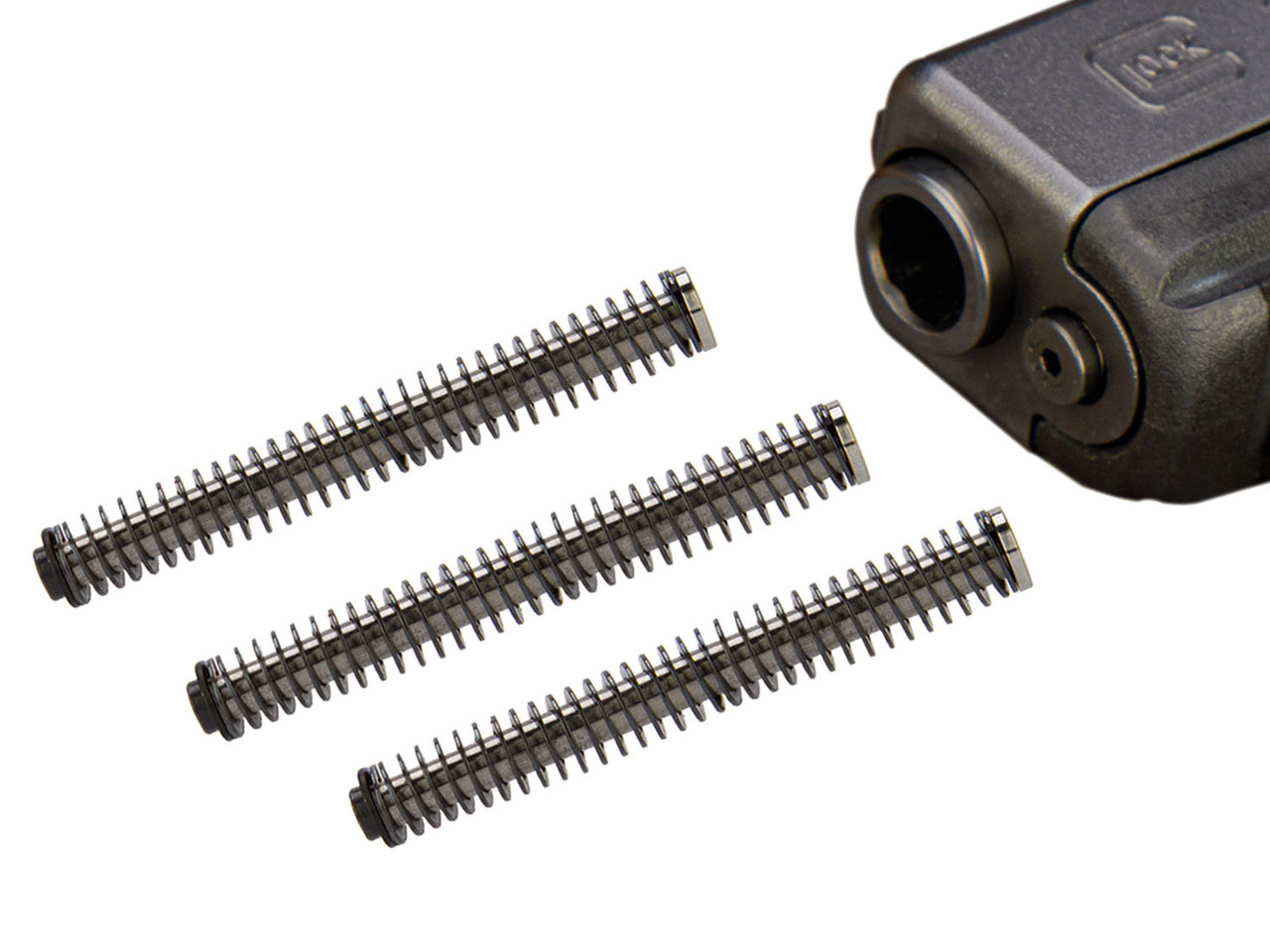
A buddy at the range looked at your older Glock, nodded at the slide, and told you to get a “solid metal” Gen 3 guide rod. Maybe it is a Gen 3 G19 you have carried for years, or a Gen 4 you picked up used. Either way, you are now standing at the counter or scrolling a parts page, wondering whether your gun actually needs this or whether it is just another thing people buy because it sounds like an upgrade.
Good instinct to pause. We machine Gen 3 guide rods in-house in Cheshire, Connecticut, so here is the plain version. For some older Glocks this is a smart, lasting fix. For others it is a feel preference you can take or leave. The answer depends on your specific gun, its generation, and one part that matters more than the rod itself.
The short answer on a Gen 3 guide rod
A steel Gen 3 guide rod is a durability and serviceability upgrade. It is not a recoil cure, and that holds for Gen 1, Gen 2, and Gen 4 owners too. If your factory polymer rod has cracked or worn, a solid stainless rod is a lasting fix that will outlive the gun.
If your Glock runs fine and you only want softer recoil, set your expectations. The felt difference on a 9mm this size is small, and you would do better spending the money on ammo and trigger time. One rule beats the whole metal question: match the recoil spring weight to your gun and your load. The spring, not the rod, changes how the pistol cycles.
What a Gen 3 guide rod actually does
The Gen 3 guide rod is the straight shaft the recoil spring rides on, sitting under the barrel. Its job is simple: keep the recoil spring aligned and compressing in a straight line as the slide cycles. The spring soaks up energy when the slide travels rearward, then pushes the slide back forward to strip and chamber the next round. The rod is the rail. The spring is the engine.
People talk about these rods as if the rod is what tunes the gun. It does not. The rod guides, the spring does the work, and keeping that straight makes every decision below easier.
What “my guide rod failed” usually means
On older Glocks the factory guide rod is polymer. Polymer is light, cheap to produce, and works fine for a lot of people for a long time. But it is plastic, and plastic does two things over years of use. It can crack at the front flange where it seats against the barrel lug, and the spring can wear a groove into it.
A cracked or grooved polymer rod will not always stop the gun cold, but it can cause inconsistent return to battery, odd ejection, or a spring that no longer sits the way it should. When someone says their guide rod “failed,” that is almost always what happened: the polymer gave up before the steel parts of the gun did. That is the real case for steel. A solid stainless rod does not crack, and it does not let the spring carve into it.
How to confirm it before you spend a dime
Field strip the gun and look at the guide rod assembly. Check the front flange, the lip that contacts the barrel, for hairline cracks. Run a finger down the shaft and feel for a worn channel where the spring rides. Look at whether the spring sits square and the coils are even, not splayed or kinked.
If the polymer is cracked or grooved, or the spring is visibly tired, that is a real reason to replace the assembly. If everything looks clean and the gun runs to slide lock every time, your guide rod has not failed. You are in preference territory now, not repair territory.
Factory vs. solid steel vs. tungsten: what actually changes
Weight and where it sits
A steel rod weighs more than the polymer one it replaces, and that weight sits low and forward, right under the barrel. On a compact 9mm like a G19 or G23, the gun itself is light, so a heavier rod is a slightly larger fraction of the total weight than it would be on a big steel pistol. That is the kernel of truth behind “steel rods tame recoil.” A bit more mass down low can make the gun feel a touch more planted in the hand.
What a heavier rod does in the firing cycle
Added mass at the front of the gun resists muzzle flip during the brief moment the slide is cycling, and some shooters feel the sights settle back onto target a hair faster. This is real, it is physics, and it is also subtle. You might notice it across a long string of rapid fire. It will not transform how the pistol shoots.
What it does not do
A steel rod does not make the gun more accurate. Accuracy lives in the barrel, the sights, the trigger press, and you. It does not cut recoil by some headline percentage either, and anyone quoting you a number is guessing. The rod material by itself does not change how the gun cycles. That last point deserves its own line.
Captured vs. non-captured
This is the part that actually splits the older Glocks, and it is worth getting right. Gen 1, Gen 2, and Gen 3 Glocks shipped with a single recoil spring riding on a non-captured rod, meaning the spring and rod come apart as separate pieces when you handle them. Gen 4 and Gen 5 moved to a captured dual-spring assembly: two nested springs held together as one self-contained unit, with a larger front diameter. The generations are not cross-compatible without an adapter.
Why does it matter to you as a buyer? An assembly with a removable tip lets you change spring weights yourself, instead of buying a whole new unit every time. The Gen 1-3 assembly we build is a captured-style unit with a hex screw removable tip, so you get swappable springs on a platform that originally shipped non-captured. The Gen 4-5 assembly carries the same hex screw removable tip. In both cases, removable means you can tune the spring without replacing the rod.
The spring is the variable that matters
Here is what the rod-versus-rod arguments miss. If you want to change how your Glock cycles, how hard the slide slams, or how the gun feels with a particular load, you change the recoil spring weight, not the rod metal. A heavier spring slows the slide and can soften the felt impulse with hotter ammo. A lighter spring helps the gun cycle reliably with softer target loads.
This matters more on compact older Glocks because they are short and snappy, which makes them more sensitive to spring weight than a full-size gun. Get the spring wrong and you can cause failures to feed, failures to return to battery, or brass landing in the next county. The rod is the rail. The spring is the dial.
Does an older Glock (Gen 1 through Gen 4) actually need one?
- Recoil: Be honest with yourself. A heavier steel rod can make a light compact 9mm feel slightly more settled, but the felt difference is small and not guaranteed to be noticeable for everyone.
- Durability after failure: Real. If your polymer rod is cracked or worn, solid stainless is a permanent fix that will not fail the same way.
- Serviceability: Real, and especially relevant on these older guns. A removable-tip assembly lets you swap spring weights to tune the gun for your ammo, without buying a new unit each time.
- Feel and preference: Real, but personal. Some shooters simply like the heft and the peace of mind of a steel part where plastic used to be. That is a valid reason. Just call it what it is.
One caution before you order: match the spring weight to your gun and your ammo. On a short, snappy compact, the wrong weight is the fastest way to turn a reliable Glock into a finicky one. If you are unsure, start at or near the factory weight for your model and load, then adjust only if you have a specific reason. Reliability first, feel second.
A word on tungsten, since it comes up. Tungsten rods are heavier than steel, and a few competition shooters chase that extra front-end mass to flatten the gun for fast strings. The tradeoff is real: tungsten is denser but more brittle, and it costs considerably more. For a carry or range gun, that is usually more rod than you need, and we do not make a tungsten rod for this platform.
If maximum muzzle control for competition is your goal, look into tungsten generically and weigh the cost against the brittleness. For everyone else, solid stainless covers it.
How to verify exact fitment
Guide rod fitment is generation-specific and model-specific, and this is exactly the platform where people get burned. A Gen 3 G19 rod will not fit a Gen 4 G19, because the Gen 4 uses the larger captured dual-spring assembly. Before you buy, know four things: make, model, generation, and any variant, like an X, MOS, or compact designation. Match all four.
Treat “fits most 9mm Glocks” or “universal Glock guide rod” as a red flag. There is no universal Glock guide rod across these generations, full stop. A seller who cannot tell you the exact models and generations a part fits is a seller to skip. For reference, here is how our two assemblies break down.
- Gen 1-3 assembly: Fits Glock Gen 1-3 models G19, G23, G32, and G38. Does not fit Gen 4 or Gen 5.
- Gen 4-5 assembly: Fits Gen 4 models G19, G23, G32, G38, and Gen 5 models G19, G19X, G45, G47.
Own a Gen 4 G19? You want the Gen 4-5 assembly, not the Gen 1-3 one. Own a Gen 3 G23? You want the Gen 1-3 assembly. Confirm your generation by checking the markings and the spring assembly itself. A single spring on a separate rod points to Gen 1-3. A fat captured two-spring unit points to Gen 4-5.
What we build, and why it is made the way it is
We machine these guide rods ourselves in Cheshire, Connecticut. Both assemblies use a solid stainless steel body that will not rust, corrode, crack, or let the spring wear a channel into it, which is the exact failure mode that sends polymer rods to the trash. Both also have a hex screw removable tip, so you can change spring weights yourself rather than buying a new assembly every time you want to retune.
The springs are ISMI premium springs, made with certified aerospace-specification alloys. You choose your weight: 13 lb, 15 lb, 18 lb, or 20 lb, with a 22 lb option as well. That spread lets you set the assembly to your model and your ammo, instead of accepting one fixed weight. Every NDZ part carries a lifetime warranty against manufactured defects. We make these because we shoot these guns, and a part this central to reliability should be steel you can service, not plastic you replace.
So, should you do this?
- Your polymer rod is cracked, grooved, or the spring looks tired: Yes. This is the clearest case. Replace it with solid stainless and stop thinking about it.
- You want to tune spring weight for different loads: Yes. A removable-tip assembly plus a couple of ISMI springs gives you that flexibility on a platform that shipped with a fixed setup.
- You shoot a lot and want a part that outlasts the gun: Reasonable yes. Steel does not fail the way polymer eventually can.
- You just want softer recoil from your daily 9mm: Maybe, but set expectations. The felt change is small, and your ammo choice and grip will do more.
- Your gun runs perfectly and nothing is worn: No rush. There is no failure to fix, so this is preference only.
If you do need one
You have decided it is time. Match the part to your generation. For Gen 1 through Gen 3 guns (G19, G23, G32, G38), the assembly you want is our Glock Gen 1-3 guide rod assembly. For Gen 4 guns, and Gen 5 if that is what you actually have, the right unit is the Glock Gen 4-5 guide rod assembly. Pick your spring weight based on your model and load, and start near factory if you are not sure.
Want the bigger picture on how guide rods, springs, and slide tuning fit together across the Glock lineup? Our guide rod pillar guide walks through it. If you are specifically on a newer gun, we cover the Glock 19 Gen 5 case in its own article. Whatever you decide, here is the honest close: if your gun runs fine and nothing is worn, keep your money. A guide rod swap is a real upgrade when there is a real reason for it, and a nice-to-have when there is not.
Frequently asked questions
Does a steel Gen 3 guide rod reduce recoil on a Glock 19?
A steel rod adds a little mass low and forward, so it can make a light compact like the Gen 3 G19 feel slightly more planted. The felt difference is small and not guaranteed for every shooter. If softer recoil is your only goal, the recoil spring weight and your ammo choice will do more than the rod material. Steel is better understood as a durability and serviceability upgrade than a recoil fix.
Will a Gen 3 guide rod fit my Gen 4 Glock?
No, not without an adapter. Gen 1-3 Glocks use a single non-captured spring on a smaller rod. Gen 4 switched to a larger captured dual-spring assembly, so the parts are not directly interchangeable. Buy the assembly that matches your exact generation. For a Gen 4 gun you want the Gen 4-5 assembly, not the Gen 1-3 one.
What spring weight should I run in my older Glock?
Start at or near the factory weight for your model and your usual load, then adjust only if you have a specific reason. Compact older Glocks are short and snappy, which makes them sensitive to spring weight, and a wrong choice can cause feeding or return-to-battery problems. Our assemblies come in 13 lb, 15 lb, 18 lb, 20 lb, and 22 lb, so you can fine-tune. Reliability comes before feel every time.
Is a polymer factory guide rod actually a problem?
Not until it wears. The factory polymer rod works fine for years for most people, and Glock designed it on purpose. The issue is that polymer can eventually crack at the front flange or let the spring wear a groove, which can cause inconsistent cycling. If you field strip your gun and the rod is cracked or grooved, that is the moment a solid stainless replacement makes clear sense. If it looks clean, there is no urgent problem to solve.