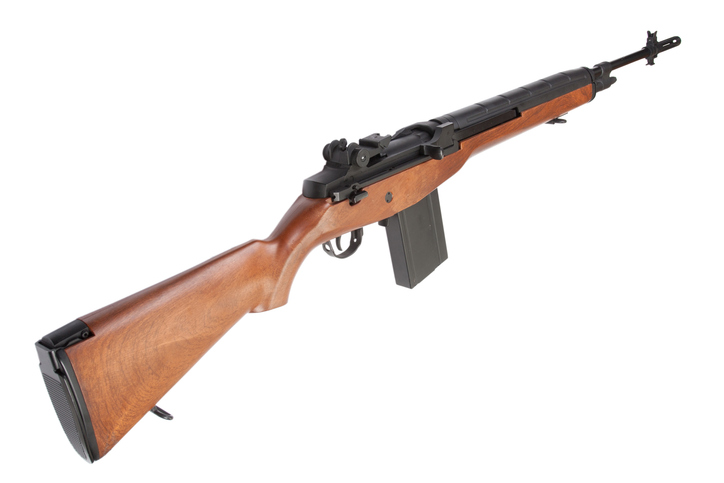
A CMP M14 is about to become a rifle you can actually buy. The Civilian Marksmanship Program announced in late July 2026 that it will sell surplus M14 rifles to civilians, converted to semi-automatic before they ship. Here is CMP’s statement, in full:
“By special authorization, the CMP is pleased to announce the future availability and sale of surplus M14 rifles. Prior to sale, the rifles will be modified to be permanently and irreversibly semi-automatic rifles.”
In fact, that is very close to everything CMP has actually confirmed.
The $4,000 price tag, the 150,000-rifle inventory, the lottery system, the grading tiers: none of that came from CMP. Some of it is educated guessing from people who have tracked surplus releases for two decades, which is worth something. It is still guessing. Writing in Firearms News on August 5, David Fortier put it plainly: “any prices being tossed around on the web are purely speculation.”
Which leaves the part you can act on today: your own paperwork. CMP’s rules are not hard. Two of them take weeks or months if you are starting from nothing. Wait until the order form goes live and you will be hunting for a birth certificate while other people are already submitting.
What’s confirmed vs. what isn’t
| Question | Status | What we actually know |
|---|---|---|
| Will CMP sell M14s? | Confirmed | Yes, by special authorization |
| Semi-auto only? | Confirmed | “Permanently and irreversibly semi-automatic,” per CMP |
| When? | Approximate | First orders anticipated late 2026 to early 2027 |
| How will they sell them? | Partially confirmed | Both mail-order and physical store sales under consideration |
| Eligibility rules? | Expected, not stated | CMP’s standard requirements are widely expected to apply. CMP has not published M14-specific rules. |
| Price? | Not announced | Speculation runs $2,500 to $6,000. CMP has said nothing. |
| How many rifles? | Not announced | ~150,000 gets repeated a lot. Not confirmed. |
| Purchase limits? | Not announced | Some limit is likely. No details yet. |
| Grading standards? | Not announced | No M14 grade tiers published |
| Lottery or first-come? | Not announced | The M1911 lottery is the obvious precedent, but that is inference |
So bookmark that table. Then, when someone in a forum thread tells you the Service Grade M14s are going for $3,800, you will know which column that belongs in.
Why the CMP M14 conversion is the whole story
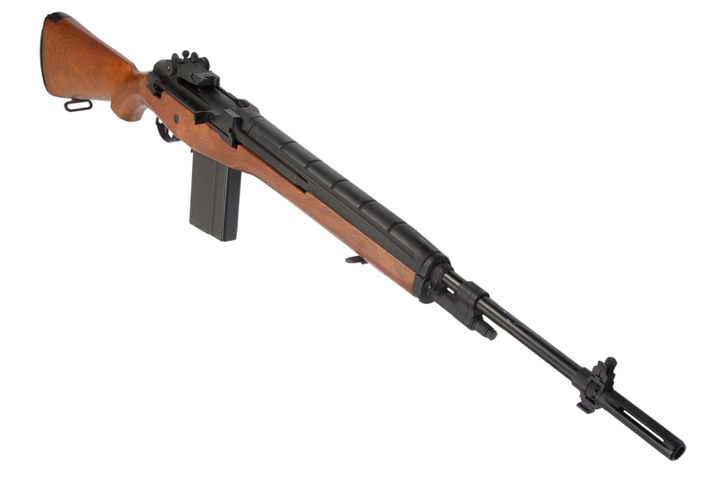
The M14 was built as a select-fire rifle, with a selector on the right rear of the receiver. Plenty of issued rifles had that selector locked out so troops could only fire semi-automatically. Legally it changed nothing. The receiver itself is a machine gun under the National Firearms Act, and the receiver is what matters here.
ATF’s long-running position has been that a receiver manufactured as a machine gun remains one forever, no matter what you do to it afterward. That single interpretation is why “CMP will sell M14s” struck a lot of people as impossible when the news broke.
Even so, CMP’s language is careful. Each CMP M14 will be “modified to be permanently and irreversibly semi-automatic.” The finished rifles then comply with the law that lets CMP sell surplus .30 caliber rifles. That authority sits in 36 U.S.C. §40732, which covers “caliber .30 surplus rifles” and traces back to the FY1996 National Defense Authorization Act. It is the same statutory hook behind Garand and M1 Carbine sales.
What CMP has not said about the conversion
What CMP has not published is the technical method. Reporting on the announcement indicates the conversion was cleared with ATF, but the mechanics are unstated. New semi-auto receiver? Permanently altered original? Something else? Nobody outside CMP can say.
Honestly, that question interests us more than the pricing chatter does, and it is getting a fraction of the attention. It sets collector value. It also decides what you are really holding when the box arrives.
The 1965 precedent behind the CMP M14 conversion
This has been done before, and the paperwork survives.
In the mid-1960s the Army converted M14s for civilian marksmanship use under AR 920-25, “Rifles, M14M and M14NM, For Civilian Marksmanship Use,” dated 8 February 1965. The M14M was the modified service rifle. The M14NM was the National Match version. Collector sources describe the process as welding the selector shaft, selector shaft lock, lock pin and sear release to the receiver, so the fire-control parts could never be reassembled for automatic fire.
Here is the part that matters. The Director of the Alcohol and Tobacco Tax Division at the IRS, the agency that became ATF, ruled that M14M and M14NM rifles modified that way were not subject to the National Firearms Act. They went to civilians legally.
Why 1968 closed the door
Then the Gun Control Act of 1968 amended the NFA to bar the sale of previously modified automatic weapons, M14M and M14NM among them. That act shut the door the 1965 ruling had opened, three years after it opened.
That history explains the phrase CMP keeps using. “Special authorization” is not new legal theory. It is a route back to a determination the government already made once, before 1968 shut it.
Two cautions. CMP has not said it is following the 1965 process, and this is a precedent rather than a confirmation. Forum consensus expects a weld of the selector components, with debate over whether the receiver’s selector lug gets machined off as well. Until CMP publishes the method, that remains informed guesswork by people who know these rifles well.
Still, two things do follow. You will not be buying a machine gun; whatever ships will sit outside the NFA, which is the entire point of the conversion. You also will not be buying an untouched USGI rifle. If originality is the reason you want one, adjust that expectation now rather than after you have sent a check.
CMP M14 vs M1A: what is the difference?
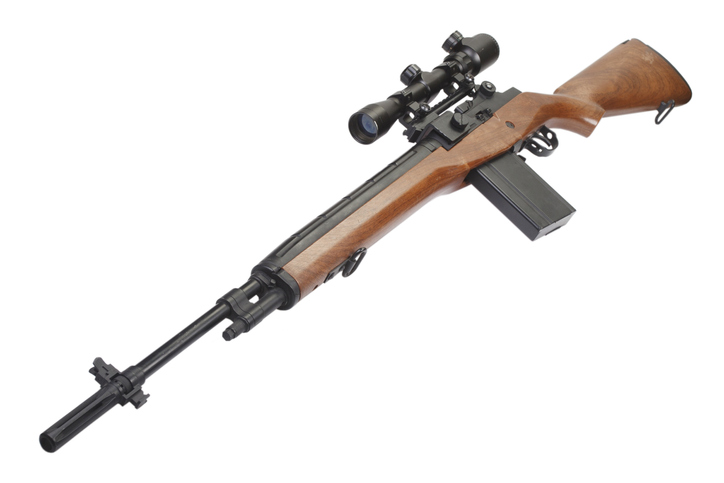
If you have shopped this platform before, you have run into the Springfield Armory M1A. It is the commercial semi-automatic version of the M14, built on a semi-auto-only receiver from the start and sold to civilians since 1974. Same manual of arms, same magazines, and it was never an NFA item to begin with.
A converted CMP M14 lands between a USGI rifle and an M1A. Original military parts, semi-auto operation, and a receiver nobody outside CMP can describe yet.
As a result, the accessory market already exists. Anything built for the M1A pattern is where to start if you are planning ahead.
Optics are the clearest example. The M14 receiver has no flat top to bolt a rail to, so glass goes on a side mount. The Leapers UTG M14/M1A 4-point locking scope mount is listed for both patterns and runs $36.97, which is the cheap way to find out whether you actually want optics on the rifle before spending $164 on the Springfield OEM mount.
CMP eligibility, requirement by requirement
CMP’s published purchase eligibility requirements rest on four things. CMP has not said M14 sales will use these exact rules. Every surplus rifle program it has run does, though, and getting ready for them costs you nothing if the details shift later.
Citizenship and age
A copy of a U.S. birth certificate, passport, proof of naturalization, or any official government document showing U.S. birth or citizenship. Your citizenship document usually doubles as proof of age. When it does not, a driver’s license or state ID covers it.
In addition, watch the state overlay on age. Residents of Washington, California, Florida, Illinois, Hawaii, New York, Delaware, New Jersey, Rhode Island, Vermont, and D.C. must be 21 or older for rifles.
Membership in a CMP-affiliated organization
CMP’s wording here is blunt: “This requirement cannot be waived.” You submit a copy of a current membership card or other proof, and there is no path around it.
In practice, the qualifying list is wider than most people assume. Shooting clubs, obviously. But veterans organizations count too, including the VFW, American Legion, DAV, and Marine Corps League, along with active and reserve military, National Guard, and professional law enforcement associations. A lot of buyers turn out to already qualify through something they joined years ago and forgot about.
So start here if you are starting anywhere. Above all, it has the longest lead time, and some clubs only meet monthly.
Proof of marksmanship activity
You have to show participation in a marksmanship-related activity, or otherwise demonstrate familiarity with safe firearm handling and range procedure. It does not have to be highpower rifle. Smallbore, pistol, air gun, and shotgun activity all count.
Acceptable documentation covers a lot of ground:
- Military or law enforcement service
- An NRA or CMP classification card
- Competition results
- A completed clinic
- A hunting license
- A concealed carry permit
- Certification from a range official
One exemption, and it catches people by surprise. No proof of marksmanship is required if you are over 60, for military surplus rifles.
Under 60 with nothing on paper? This is the second slow one. A hunting license or a CCW permit is usually the fastest route. A CMP-sanctioned clinic is the more thorough one, and it has the side benefit of actually improving your shooting before you own the rifle.
The background check
CMP submits your application information to the FBI’s NICS system. If your state or locality requires a permit, license, certificate, or FOID card to receive a rifle, a photocopy goes in with the application.
California buyers get one more constraint: one firearm per 30-day period. That matters if you were hoping to pair an M14 order with anything else.
Worth saying plainly, because it is the thing most likely to waste your time: some states will not allow these at all. Shooters in Washington and other states with assault-weapon or feature-based restrictions are already assuming they are out. CMP screens against state law, so check your own before you spend a year on club membership and paperwork.
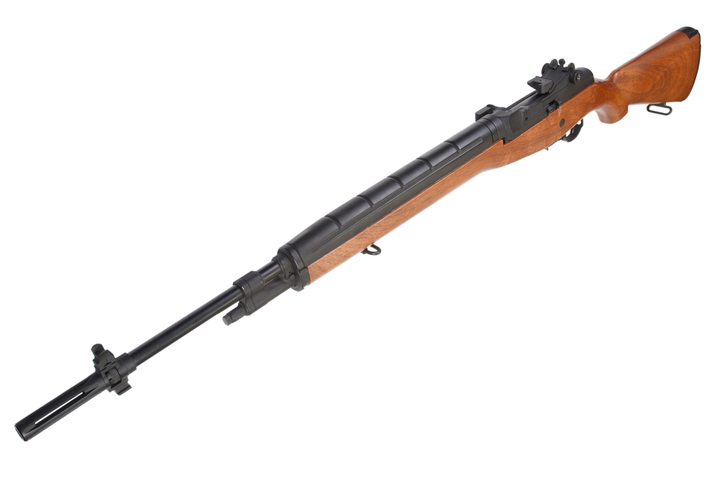
How CMP grades rifles, and what to check on a CMP M14
So far, CMP has not released CMP M14 grading standards. What it has published, and has used for years, is the M1 Garand grade structure. That is the most reliable template we have.
The grades turn on two measurements above all: muzzle erosion (ME) and throat erosion (TE). Both are gauge readings, not opinions. That is exactly why they anchor the system.
| Grade | Muzzle erosion | Throat erosion | General condition |
|---|---|---|---|
| Collector | 2 or less | Under 3 | 95%+ original finish, all original parts |
| Correct | 2 or less | Less than 4 | 80%+ original finish, date-correct parts |
| Service | 3 or less | Less than 5 | Good to very good, bright bore |
| Field | 3 or more | Less than 6 | Significant wear, serviceable bore |
| Rack | More than 3 | May exceed 5 | Heavily used, dark bore, sold as-is |
| Expert | “As new” | “As new” | New commercial stock and barrel |
The lower the number, the less the bore has worn. A Service Grade Garand at ME 3.0 and TE 4.5 is a rifle that will shoot acceptably. A Rack Grade at ME 3+ with TE over 5 is a rifle you buy for the receiver and the history, and you should plan on a barrel.
So here is the part that costs people money. CMP does not guarantee a specific gauge reading within a grade. Service Grade means “3 or less,” which covers a rifle reading 1.5 and a rifle reading 3.0. Those are not the same rifle, and they are not worth the same money. When you take delivery, your first job is finding out which one showed up.
Gauge the muzzle yourself
So gauge it yourself. A muzzle erosion gauge is a simple stepped pin. It drops into the crown and reads how far the bore has opened up past nominal.
Our .30 caliber muzzle bore erosion gauge reads from .2990 to .3025 in .0005-inch steps. The 00 baseline sits at .3000 inches. It is stainless, cut in the U.S., and listed for M1 Garand, M1 Carbine, 1903, and M1A.
At $13.99 it costs less than a box of match ammo. In about four seconds it tells you whether the grade you paid for is the grade you got.
Two honest caveats on that. It measures muzzle erosion only, not throat erosion; throat readings need a separate throat gauge. And its listed compatibility covers the M1A, not the M14 specifically, because until CMP describes the conversion nobody can state M14 fitment as fact. The bore diameter is the same .30 caliber family, but “should be fine” is not the same as verified, and we would rather say so.
Look past the bore too. First, check the stock for cracks at the wrist and behind the receiver. Check the crown for nicks, which wreck accuracy no matter what the gauge says. Then look at the gas system. On a surplus rifle, the gas cylinder and piston say a lot about how it was cared for.
What will a CMP M14 cost?
So far, nobody knows what a CMP M14 will cost. What we have instead is precedent, and precedent has limits.
CMP’s published Garand pricing gives some shape to it. Expert Grade Garands list at $1,150 plus $35 shipping. Service, Field, and Rack Grade are all marked sold out. Service Grade went out in October 2024, Field Grade in December 2025. That sold-out status is the most useful thing on the page, because it tells you how these releases end.
The CMP M14 will not price like a Garand, though. The conversion is an extra step someone has to pay for. And demand for a rifle that was functionally unobtainable in this configuration is going to be ugly.
Circulating estimates run from about $2,500 to $6,000, and where a number sits in that spread tells you who is guessing. The high end comes from general online chatter. The lower end, roughly $2,500 to $3,000 for what amounts to a Service Grade rifle, comes from collectors closer to Anniston who expect the program to mirror the Garand structure: priced by manufacturer and grade, with National Match examples sold at auction instead of over the counter.
Treat the whole range as a planning number, not a forecast. Informed people have guessed wrong about CMP pricing before.
Manufacturer will likely matter to price and demand. Springfield Armory, Winchester, Harrington & Richardson and TRW all built M14s, and collectors already have preferences among them.
Budget beyond the CMP M14 itself
What is worth budgeting beyond the rifle itself:
- Shipping, which CMP charges separately
- Any state-required permit or transfer fees
- Club membership dues, if you are joining for eligibility
- Magazines, since surplus rifles rarely ship with a useful supply. Springfield OEM 10-rounders for the M1A in .308 run $34.99 and fit the pattern
- Basic inspection and cleaning gear, which runs well under $100 total. A schematic gun mat for the M1A is $24.99 and keeps small parts off the bench when you strip it the first time
If a lottery does materialize, as it did for the M1911 releases, there is a second cost worth naming: your money may be committed or your order queued for a long time before anything ships. Plan for that in cash flow, not just in total.
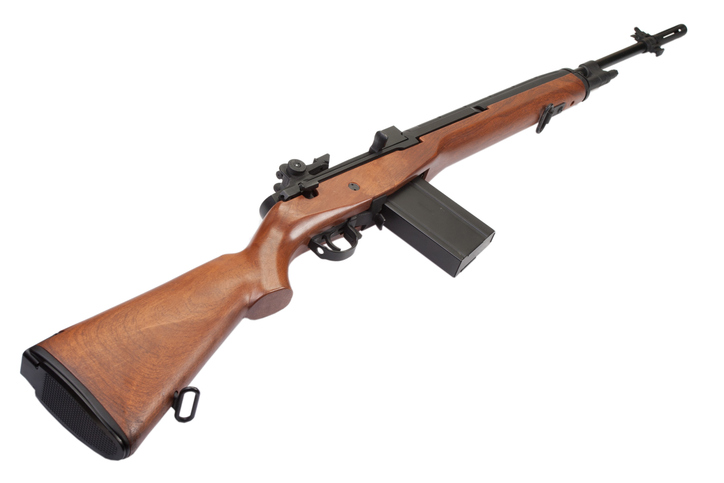
Your CMP M14 checklist for the next 90 days
Above all, nothing on this list depends on CMP announcing anything else.
- Join a CMP-affiliated organization if you are not already a member. This is the one rule that cannot be waived, and it has the longest lead time.
- Pull your citizenship document. Locate the birth certificate or passport now and make a clean photocopy. This is the step people discover is a problem at the worst moment.
- Establish marksmanship proof if you are under 60 and have none. Hunting license, CCW permit, competition result, or a CMP clinic.
- Check your state’s rules. Age minimum, permit rules, and any limit on how often you can buy.
- Verify you can pass NICS. If there is any doubt, sort it out before your form is in.
- Set the money aside. Assume the high end of the speculation range rather than the low end.
- Watch thecmp.org directly, not aggregators. The order form and the real rules will appear there first.
- Get a muzzle gauge before the rifle arrives, so you can check it the day it lands instead of ordering one afterward.
If you are new to surplus buying generally, our guide on questions to ask before buying a firearm covers the diligence that applies to any purchase at this price point.
Read next
AR-15 Barrel Profiles: Government, Pencil, M4 – because barrel wear and profile change what a rifle actually does downrange.
Frequently asked questions
How much will a CMP M14 cost?
CMP has not announced pricing. Estimates run from about $2,500 to $6,000, and all of them are guesses. Collectors expecting the program to mirror the Garand structure put a Service Grade equivalent nearer $2,500 to $3,000, with National Match examples auctioned. For scale, CMP’s Expert Grade M1 Garand currently lists at $1,150 plus $35 shipping.
Can you legally buy an M14?
You will be able to buy CMP’s converted version. CMP states the rifles will be “modified to be permanently and irreversibly semi-automatic” before sale, which takes them outside the National Firearms Act. CMP has not published the conversion method or the ATF determination behind it. An original select-fire M14 remains a machine gun, and that is not what CMP is selling.
Is the CMP M14 an NFA item?
No. Per CMP, the permanent semi-auto conversion is what keeps these rifles off the NFA registry and compliant with 36 U.S.C. §40732, the statute authorizing CMP to sell surplus caliber .30 rifles.
When will CMP M14 sales start?
CMP anticipates fulfilling the first orders sometime between late 2026 and early 2027. No order form or firm date has been published.
How many M14s will CMP have?
Unconfirmed. A figure around 150,000 gets repeated a lot, but CMP has not given a count.
Do I have to belong to a club to buy from CMP?
Yes. CMP’s published requirements state that the membership requirement “cannot be waived.” Shooting clubs qualify, and so do veterans organizations such as the VFW, American Legion, DAV, and Marine Corps League, along with active and reserve military, National Guard, and professional law enforcement associations.
Do I need proof of marksmanship activity if I’m over 60?
No. CMP waives the marksmanship activity requirement for purchasers over 60 on military surplus rifles. Every other requirement still applies.
How will CMP make the M14s semi-automatic?
CMP has not published the method. There is a documented precedent, though. Under AR 920-25 in February 1965 the Army converted M14s into the M14M and M14NM for civilian marksmanship use, welding the selector components to the receiver, and the IRS division that preceded ATF ruled those rifles were not NFA firearms. The Gun Control Act of 1968 later barred their sale to civilians. Whether CMP repeats that exact process is unconfirmed.
Can buyers in every state get a CMP M14?
No. CMP screens purchases against state and local law, and states with assault-weapon or feature-based restrictions may block these rifles entirely. Check your own state’s rules before starting the eligibility process.
What is the difference between an M14 and an M1A?
The M14 is the U.S. military’s select-fire service rifle. The Springfield Armory M1A is the commercial semi-automatic version, built on a semi-auto-only receiver and sold to civilians since 1974. CMP’s converted M14s will operate semi-automatically like an M1A while carrying original military parts and history.
Sources: Civilian Marksmanship Program · CMP M1 Garand grades and pricing · Firearms News, David Fortier, August 5, 2026
This article covers CMP’s published requirements as of August 7, 2026. CMP has not released M14-specific rules, pricing, or grading standards. Verify all requirements at thecmp.org before submitting an application. Nothing here is legal advice.